This week’s episode deals with the impact of Martin Luther King Jr.’s assassination, and how tragedy supposedly brings people closer together. Ginsburg’s father spells out this idea most clearly when he chastises his son for not using King’s death as an opportunity to bond more closely with the date his father set him up with, citing the biblical flood as a precedent. It’s a theme that plays out in various ways over the course of the episode, although in many cases, Mad Men’s damaged characters can’t quite bridge the gap between themselves and others, and in some cases they find themselves driven further apart. Peggy, for instance, is on the verge of moving into a new apartment with Abe, but when news of the tragedy hits, Abe leaves Peggy and rushes off to Harlem to write an article for The New York Times on the civil unrest there. Later, consumed by the story, he reveals that he never wanted to live on the Upper East Side. Similarly, Betty has to watch Henry rush over to Harlem to lend his supporting in the quelling of the discontent there. Other examples abound: Pete reaches out to Trudy, but this tragedy isn’t enough to bridge the gulf between them. Joan gives Dawn an incredibly awkward, unwanted, and unreciprocated hug. Don has no means of reaching Sylvia, who is away in DC. Pete and Harry have a moment of commiseration before Pete realizes that Harry is really only upset about how King’s death has screwed up SCDP’s television commercial billings because of all of the preempted programming. Pete might be grating most of the time, but he’s always been one of the most politically progressive characters on the show, and that trait shines through in the scene where he unloads on Harry over his crassness (it feels slightly odd every time the show puts me in the position of rooting for Pete, but here it felt rather vindicating, especially in the context of Harry’s self-righteousness last week).
Monday, April 29, 2013

Spring Breakers

The way the film dealt with imagery was pretty incredible. For lack of a better word, I’d describe the film’s visual track as “fractured,” organized loosely by the dialogue accompanying it. In other words, the dialogue acts as a through-line around which the images are organized, but only vaguely, like an ever-shifting kaleidoscope. The visuals skip short distances forward and backward through time, illustrating and orbiting around the dialogue or evoking the setting’s atmosphere, sometimes repeating moments for emphasis. Accordingly, very rarely are the characters actually shown speaking their dialogue; instead, a wide array of images show the speakers or their subject(s) engaged in various, emblematic actions. This visual looseness allows for a fair degree audio freedom; in fact, quite often individual lines of dialogue or brief exchanges are repeated with variations, such as different intonations, or different accompanying imagery. At least once the characters are actually shown having the same exchange twice, but with different staging (as in the exchange near the end of the film about whether or not the characters fear their upcoming assault on a gangster’s mansion). These aesthetic choices result the film being shot through with a quasi-dream-like, free-floating looseness.
This stylistic looseness matches the looseness of the plot. The four female protagonists have only the most minimal of goals – get to Florida for spring break – which are quickly met. The film meanders from there through a loose string of coincidences and entirely new conflicts and characters, fitting for a film committed to indulging the hedonistic, consequence-free worldview of its characters.
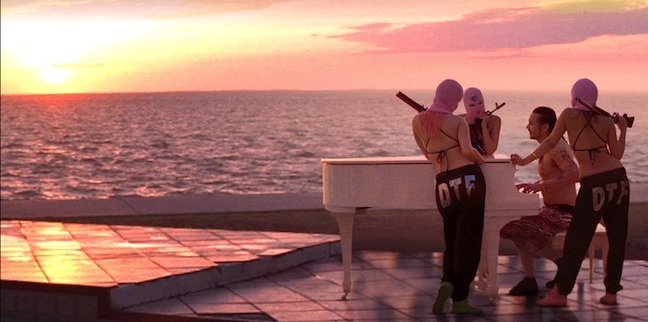

Their new partnership is nicely conveyed in an inspired, slow motion montage sequence of a series of violent heists (accompanied to Britney Spears’s “Evertyime”), but is most marvelously evident in the film’s climax. Alien, Brit, and Candy – the latter two clad in only pink ski masks and string bikinis – assault the mansion of Alien’s

Monday, April 22, 2013
Mad Men Season 6, Episode 4: “To Have and to Hold”
Monday, April 15, 2013
Mad Men Season 6, Episode 3: “Collaborators”
 As expected, this week spends a lot of time focusing on Pete, who continues the trend from last season of becoming a poor man’s Don Draper on an accelerated timescale. Like Don, he’s grown restless in his marriage to a beautiful woman and life in the suburbs.* Like Don, he’s tried his hand at a string of affairs with other women, and now, like Don, he’s decided to start sleeping with his neighbor’s wife, Brenda (in showing how foolish such a liaison turns out to be, perhaps this is a way of the show hinting at later season developments for Don and Sylvia). Pete even has the same corner office on the second floor of SCDP as Don has on the first floor (and with the furniture arranged in the picturesque way the photographers wanted Don’s furniture arranged in the premiere – Pete’s never happy, but at least he’ll maintain the image of being happy).
 Tuesday, April 9, 2013
Mad Men Season 6, Episodes 1 and 2, "The Doorway"

Monday, March 4, 2013
Girls Season 2, Episode 8, “It’s Back”

That’s what makes his outburst in the AA meeting of last night’s episode such a treat. It’s rare to have such unbridled insight into what makes this guy tick, especially when it’s so excellently written. He treats this AA group like therapy, unburdening himself of all of his frustration, confusion, and depression over his and Hannah’s breakup. It’s a raw monologue that just flows out of him, making him appear vulnerable and introspective, and in touch with himself. Particularly excellent writing included the bit where he talked about how wanted to teach her things she didn’t know (like how to use soap or what street Central Park started on). I thought it nicely representative of wanting to share things in your life with someone you love. I can’t blame Carol Kane for wanting to set up her daughter with him – based on that display, I’d want my hypothetical daughter to meet him too.

Adam and Natalia’s meeting provided more goodies. I loved the way in which it took him a moment to register that the beautiful woman walking through the door was there to see him – as if never in a million years did he think that Carol Kane’s daughter would be this person. Their mutual reactions to each other were also a delight. Adam is his usual, unfiltered self (“Holy shit!”), while Natalia says, “Oh my god, I love my mom.” The scene was great for vicarious living, indulging everyone’s fantasy of instantaneously hitting it off with a beautiful person.
Of course, the actual girls on Girls are pretty great as well. It’s as if each of the characters is in competition to be the least self-aware character on the show. For my money, Marnie is in the lead, followed closely by Hannah and Jessa, with Shoshana a distant fourth. Marnie’s self-esteem has always been wrapped up in how she compares herself with the other characters, especially her ex-boyfriend Charlie, but also the other regulars. It’s one her most unpleasant characteristics, and one of the reasons she seems like a real character (something I think is true of most of the characters on this show – their unsympathetic traits are a part of what make them seem so well-rounded). Naturally, she finds it difficult to see Charlie so successful while she’s currently in limbo as a hostess (I thought it an especially nice touch that she had her hair in childish-looking tails when she sees Charlie – quite a contrast from his put-together, office-casual appearance).
In another nice touch, Charlie finally seems to have figured out that Marnie is rather toxic for him: after stopping by his new office and telling him she's there for support, he sarcastically mutters, “Yeah, from me or for me?” Apparently, her toxicity is something he figured out a while ago: the app he sold to get the nice job he currently enjoys was predicated on his wanting to call her but knowing he shouldn’t. It’s called “Forbid,” and it’s free to download, but charges you $10 to call a person you designate to the software. In his case, he devised it to prevent himself from calling Marnie after their breakup. However, true to form, Marnie is oblivious to the obvious, and has to be told explicitly that she’s the reason he created the program in the first place (it’s possible that she knows she’s the reason why he created the app and just wants to hear him say it, although I think her reaction to the news – she thinks it is weird – favors the former inference more than the latter).
In another nice touch, Charlie finally seems to be equipped to deal with Marnie’s parasitic self-esteem issues. When Marnie fishes for details about how much Charlie got paid for the app (the better to finely adjust her self-esteem), Charlie strings her along, and they go back and forth in screwball comedy cadence:
Charlie: They paid me a shitload.
Marnie: Good.
Charlie: No, it’s not that much.
Marnie: Oh.
Charlie: But it’s enough.
Marnie: Good.
Charlie: Yup.
Then, to top it off, he asks a demoralizing question: “Do you need money? Is that why you’re here?” It’s a strange situation in which a supposedly benevolent question is actually rather malicious, but given the way Marnie has treated him in the past, it’s well-deserved.
Meanwhile, the pressure of the deadline for her book deal causes Hannah to suffer a recurrence (apparently) of her OCD. I like that the writers have created consequences of the pressure Hannah is feeling, but I’m not terribly thrilled with this development. On the one hand, it led to a nice scene between her and a therapist, where she angrily describes how crippling the OCD has been for her in the past.* On the other hand, if her OCD was indeed so severe, it doesn’t seem to me like this would be the first time we’ve heard of it. Hannah is so quick to talk about her personal issues with anyone that it seems like this is something she would have raised at some point in the past (I can envision it now: she raises it as an example of the struggles she’s gone through in an attempt to win points in an argument over her behavior. Or she raises it as an instance of what an interesting person – and therefore good writer – she is). Perhaps it isn’t something that would have come up over the course of the first season, but it felt a bit like lazy, retroactive continuity.
* I liked Hannah’s outburst both for its dramatic weight, but also because it’s typically Hannah – her anger is a product of the therapist suggesting her OCD is “classical,” as if he is categorizing her pain as no different from that of others who suffer from her disorder. Now, this might be upsetting for a lot of people, but Hannah’s particular brand of self-unawareness is her insistence that her experiences and thoughts are more powerful because they happen to her. Everything that happens to her is lived more fully than when it happens to others (even though really, she just likes to talk about it more). As Alan Sepinwall wrote in his review of the bottle episode a few weeks ago, “Hannah's pain still has to be more interesting and special than everyone else's.” Thus her anger at her therapist is slightly less sympathetic than it would be otherwise. Although, as Sepinwall insightfully points out in his review of this week's episode, her need for her experiences to be special is in part a way for her to cope with her previous powerlessness over her OCD.
Other thoughts:
- I like that Adam keeps a bottle of milk by his bedside table for so long that it curdles, yet he doesn’t think to check the milk before drinking it.
- At first, I thought Hannah’s checking over her shoulder after Adam called was her looking to see if he was stalking her, rather than a manifestation of a previously unrevealed struggle with OCD.
- Ray is a source of constant amusement. Like him, I also winced when Shoshana’s friend referred to her roller blades as “vintage.”
- I loved Marnie’s face as she assessed the attractive blonde Charlie consults with briefly in his office, and then the false smile Marnie gives Charlie when he turns back to face her. Rarely is her insecurity so baldly on display, but given where she is in her life at the moment, it works.
- Not only is Natalia beautiful, she’s also fascinating: she works with a private eye, sometimes as a decoy for his subterfuge. A real-life femme fatale!
- More hilarious honesty from Adam: “You’re very easy to talk to. I thought this was going to suck ass, but you’re very easy to talk to.” He then goes on to say he’s sweating bullets and that he’s had to pee for the past thirty minutes. And she finds this charming! Be still, my beating heart.
- Adam uses AA for therapy, while Hannah is forced to go to see an actual therapist. Some nice symmetry there.
- Poor Shoshana. Her behavior with the doorman upon leaving the party makes me wonder if she’ll ever realize that she may be happier if she isn’t so concerned with what others think of her (perhaps this is her arc for the series). As soon as she registers that the doorman is interested in her, an affected, unconvincing air of attempted coolness washes over her as she tries to conform to what the doorman might want. At least she throws her neuroses out the window long enough to hook up with him.
- Marnie “mentally budgeted six years of brokenness” for Charlie after their breakup. It’s ambiguous whether or not she means she intended for him to be broken for that long, or if that was just an estimation she made based on his behavior. Ugh.
- Marnie sums up her lack of self-awareness quite nicely in her outburst with Ray. Standing in her demeaning hostess uniform, she tells Ray, “It doesn’t matter how right you do things. You know who will end up living their dreams? Sad messes like Charlie! And the people who end up flailing behind are people like me! Who have their shit together!” (Loved Ray’s deadpan response: “Marnie learns another life lesson. How adorable.”) Kudos to Ray, though: despite his previously stated disdain for Marnie, he tries to get her to realize she should stop judging herself against others, and just focus on doing what she wants to do (which is singing, hilariously enough).
- Really, I would be happy with an entire episode of Marnie and Ray interacting. Ray tries to impress upon Marnie the urgency of her following her dreams of singing by telling her, “You’re never going to look this good again.” To which she sadly responds, “Thank you.”
Update: Apparently, seeds of Hannah's OCD have been planted in the past, but I just forgot about them or didn't notice them. See Sepinwall's review.
Monday, November 12, 2012
Skyfall

However, it dispenses with most of these conventions within about an hour or so of the film, and then becomes something else entirely. There are many ways in which the film diverges from convention. Early in the film, we see Bond in his off-hours. Apparently he seeks an adrenaline rush in both business and leisure, judging by his new drink of choice: whiskey consumed under threat of scorpion bite. Bond has lost a step, and fails both physical and psychological evaluations. A potential femme fatale figure is introduced, but then removed almost just as quickly – Bond cannot save her. Bond discovers the villain’s lair, but doesn’t destroy it, and then calls for backup. Bond’s only high-tech gadget: a gun locked to his palm print. Later, Bond does not play on offense, but defense, and the action takes place not in an exotic location, but London, and then later Scotland. We learn a smattering of Bond’s history and upbringing, such as his parents’ names and his growing up an orphan. The film’s climax does not involve Bond foiling grandiose, world-changing plans, but stopping an (admittedly elaborate) revenge murder, and is equal parts Bond film, Home Alone, and MacGyver. Finally, Bond simultaneously both succeeds and fails at foiling these plans.
All of these deviation from convention make this the most human Bond has ever seemed (perhaps outside of On Her Majesty’s Secret Service), and in my opinion, he's better for it.
Other thoughts:
- My god, Roger Deakins is a wizard. Skyfall is resplendent, every image lovingly kissed by his amazing cinematography. Two scenes are particularly breathtaking. The first has Bond sneaking up on an assassin in a Shanghai high-rise at night. Gigantic, neon advertisements dance past the windows and reflect off the glass, silhouetting Bond’s target, and surrounding Bond in a kaleidoscope of liquid-smooth pastels. The second is at the Bond estate in Scotland. The setting begins grayed in fog, but then night falls, explosions ensue, and the rest of the climax is illuminated by the warm yellow-orange glow of a raging fire. White tendrils of breath stream from Bond and company, who are lit as if the fog itself were ablaze.
- Javier Bardem is excellent. His calm, knowing, yet gentle air of superiority is continually refreshing. The only shame is that there isn't more of him.
Subscribe to:
Posts (Atom)