And so ends David Simon’s latest treatise on the American city. Tremé never had the narrative hooks that drove The Wire, but I never found the show less enthralling for it. The Wire was bleak; it offers little hope at real change and reform, instead showing time and time again that people who wish to do good deeds and effect genuine change are either ground down by their institutions, or are driven out of those institutions altogether, no matter what institution they belong to: the police, dock workers, politicians, educators, newspapermen, and even drug dealers. Tremé was significantly more positive. Certainly, its characters were ground down by institutions. The cops are mostly corrupt, as are the contractors and city officials in charge of restoring New Orleans in the wake of Katrina. But New Orleans also has music. And food. And Mardi Gras. Tremé was never about the failure of the institutions that govern the American city the way The Wire was; instead, it was about how life and culture persevere despite a city’s institutions and other flaws.
Nowhere was this clearer than in the way narrative often took a backseat to other concerns, particularly music. Tremé was always a fabulous showcase for the massive melting pot of New Orleans jazz, featuring scores of real life local musicians, and often lingering on scenes of musical performances well past the point where any other show would have cut away from them. If you found yourself checking your watch during the music scenes, then you were missing a part of the point of the show. Savoring these performances was a crucial part of the pleasure of Tremé, just as much as was watching Antoine shuck and jive his way from gig to gig, or laughing at the feuds and arguments Davis started (and usually lost), or watching LaDonna give someone the stink eye.
Nevertheless, characters were still important. Characters on Tremé persevered in face of adversity, and were even allowed small victories from time to time, which is especially clear if you examine the way many characters grew over the course of the series. Annie goes from a busker to an up-and-coming Nashville musician (even if she has to make some compromises along the way); Janette finally gets her own restaurant off the ground (and thanks to Nelson, she gets to keep her name on it); Delmond comes to terms with his roots, finding a balance between his New York jazz and his New Orleans upbringing; Sonny quits drugs and finds peace with his wife and her Vietnamese family; Antoine finds more meaning than he ever could have imagined in becoming a middle school music teacher; Toni manages to bring down a crooked cop, and even Davis finally matures (if only a little bit).
In the end, Tremé is about what makes New Orleans a special place, in both its charms and its dysfunctions, and this sensibility is captured perfectly in the series’ final scene. The show ends with an image of the makeshift mannequin Davis created at the start of the season to warn motorists of a giant, car-wrecking pothole in the middle of the road. Except now, post-Mardi Gras, the mannequin is covered in beads, feather boas, masks, and other party paraphernalia. It's a perfect synecdoche for the show's take on New Orleans culture: just like any other city, there are a lot of messed up and broken things, but the people who live there still make it their own, turning even its idiosyncrasies into a vibrant part of city life. The pothole is no longer a pothole, but a celebration of the things that make New Orleans unlike any other place in America. It’s a great end to a great show.
Other thoughts:
- Nelson was always somewhat of a disaster profiteer, but I'm glad he was able to win one for the angels in the end, selling Janette's asshole ex-partner a stake in the DOA jazz center in exchange for Janette's rights to name her restaurant after herself.
- The scene in the penultimate episode where Davis tries to get Nelson to invest in Davis' idea to open a jazz club was hilarious for many reasons (Davis' enthusiasm, Nelson's incredulity), but I laughed hardest at the scene's conclusion, when they adjourn their meeting and each head in different directions, Nelson getting into his hot little sports car, and Davis hopping on his bicycle. The two shots of them leaving are completely unnecessary for conveying the idea that the scene is over, but their different means of transportation speak volumes about the differences between their characters. Nevertheless, they were still able to form an unlikely bond through their love of Janette's food and New Orleans jazz. Food and music are each a hell of a thing.
- A sad end for Albert, but I enjoyed all of his and Delmond's scenes tremendously. It got quite dusty in my living room when Delmond played the song he had been working on for Albert.
- It's tough to choose, but Antoine is probably my favorite of the show's characters. David Simon is great at crafting characters that I simply want to spend time with from week to week (which is another part of the reason I wasn't too bothered by the show's lack of interest in plot). I greatly enjoyed the way he grew to love his students more than his own music career these past seasons. Quite a sea change in his character, but he never lost any of his swagger. He just grew a heart to accompany it, and in the process, became the man Desiree probably always knew he could be (even if he still has somewhat of a wandering eye).
- LaDonna's story is the only one that really seemed to peter out without much closure. She seemed to become more of an ancillary figure in the lives of Albert, Delmond, and Antoine. Although at least she got to reopen her bar.
- There were a number of nice moments in the final musical montage (including Terry railing against his sons buying Colts jerseys while he sports a Saints jersey), but my favorite was probably Annie telling off her producer when he tried to interfere with her recording session. She offers him her violin and clearly mocks him by asking something like, "You want to play it?" Way to stand up for yourself, Annie.
Monday, December 30, 2013
Monday, September 30, 2013
Breaking Bad, Season 5, Episode 16 “Felina”
Wow. The final episode of this magnificent series is nothing short of a masterpiece. There are many reasons for its greatness, the first being that it neatly resolves all of the series’ plotlines, both longstanding and recent. In the end, Walt wins. He accomplishes most of his goals, or he does his best to see that they are carried out: he manufactures a way for Flynn to receive and even possibly accept the money Walt has left (even if he can ensure neither that Flynn will use it as Walt wishes, nor that its source will remain concealed)*; he settles scores with both Lydia and with the Aryans; he gets to say goodbye to his wife and daughter; he frees Jesse and makes a sort of peace with him; he dies on his own terms, and most importantly, he gets to keep what has always been most important to him - his reputation, and in turn, his pride. I’m sad Breaking Bad has to end, but an ending this rich and rewarding is worth much more than being unable to enjoy more new episodes.
Monday, September 23, 2013
Breaking Bad Season 5, Episode 15, “Granite State”
I thought last week’s episode went about as far as Breaking Bad would go in destroying the lives of its characters, but the penultimate episode has proven me wrong, as this week, things fall to pieces even further: Walt must flee New Mexico and hide out in a cabin in New Hampshire; he loses what little connection he thought might still remain between himself and his family, as well as what little pride he had left in his accomplishments, and he also inadvertently invites into Skyler's life the threat of danger that so terrorized her when she first began to learn about Walt’s life as a meth cook.Monday, September 16, 2013
Breaking Bad Season 5, Episode 14, “Ozymandias”
Many points of no return are finally reached in this week’s amazing episode: Walt finally tells Jesse he watched Jane die; Skyler finally listens to her conscience and breaks with Walt; Walt Jr. finally finds out the truth about his dad; Walt finally gets found out by the greater law enforcement community, and he also finally has stripped away from him the last vestiges of the illusion that he can survive the consequences of his actions with his family intact. These were plot points I hoped and suspected that Breaking Bad would hit eventually, but despite the show’s excellent track record, I was still unprepared for how stellar (and devastatingly) they would be handled. This episode is unequivocally the best of the season so far, and perhaps the very best of the entire series.
Monday, September 9, 2013
Breaking Bad Season 5, Episode 13, “To’hajiilee”
This whole final season (in fact, much of the entire series) is like a five or six-way chess game, with characters making moves and counter-moves and thinking three turns ahead. Or perhaps a better analogy is that Walt is playing multiple games of chess at once, like a Bobby Fischer prodigy: currently, Walt’s game with Skyler involves keeping her placated by containing Jesse’s rage; his game with Jesse has always involved manipulating Jesse into doing what Walt wants; his game with Hank revolves around not getting caught, and he put Hank in check two weeks ago with his false video confession. This week, Hank and Jesse are maneuvering the pieces to try to nail Walt with evidence, while Walt sets up a defense, trying to flush out Jesse by contacting Andrea and Brock. Walt’s play with Andrea is a good one, and probably would have worked too, but Hank has foreseen it, and has preemptively put Jesse’s communication with the world on lockdown, snuffing out the threat.
Monday, September 2, 2013
Breaking Bad Season 5, Episode 12, "Rabid Dog"
This is a sad episode for Walt, possibly one of the saddest of the series, as it shows how thoroughly Walt has lost the trust of nearly everyone to whom he’s closest. He’s manipulated everyone so fully for so long that no one trusts him anymore, even when he’s being genuine. He’s a bizarro version of the boy who cried wolf (bizarro because in his case, the lie is that everything has been normal, rather than calamitous). Admittedly, Walt has been lying a lot lately, as evidenced by the song and dance he does for Skyler and Walt Jr. when he realizes he’ll be unable to completely hide Jesse’s break-in from them. He pours gas on his clothes, splashes it in his car, and then makes up a half-baked story about spilling gas on himself at a gas station. The story isn’t even good enough to fool Walt Jr., who senses Walt is lying, but doesn’t understand why (he thinks it’s to cover up for passing out again). Skyler sees right through the entire story, however, and when she forces Walt to tell her the truth, she encourages him to kill Jesse. Saul does the same thing earlier in the episode, and each time, Walt is shocked and dismayed by the suggestion.
Monday, August 26, 2013
Breaking Bad Season 5, Episode 11, “Confessions”
Finally! Finally, Jesse the ticking time-bomb has been activated. It would not have been very satisfying for Jesse to have gone away quietly into the (Alaskan) night, never having learned what Walt did to Brock and/or Jane. Ever since we discovered Walt poisoned Brock (or ever since Walt let Jane die), Jesse’s discovery of Walt’s depravity has been like a shoe waiting to drop. While Jesse might be disillusioned with Walt, sick to death of Walt’s attempts to manipulate him, and strongly suspect that Walt killed Mike, Jesse still has not yet had a good enough excuse to turn on Walt, and certainly not a good enough reason to betray him to Hank, whom Jesse still loathes (Jesse has not, evidently, forgotten about the beating Hank gave him).
Monday, August 19, 2013
Breaking Bad Season 5, Episode 10, “Buried”
Something this show excels at is creating dynamic, psychologically rich situations – the goals, intentions, beliefs, and emotions of each of the characters in many situations are strong and clear, which creates a lot of rich opportunities for us to infer what’s going on in the heads of the characters on an almost beat by beat basis (especially when the acting is this good). This is the case not only for one or two principle characters, but for most of the main characters on this show. For example, after Walt leaves Hank’s garage (amusingly shot like a western standoff, complete with twitching trigger fingers, but ending with the closing of a door rather than the drawing of a gun), they both immediately call Skyler, who is the linchpin in both men’s plans. For Hank, she’s a potential witness to Walt’s crimes, one who can provide crucial evidence. For Walt, she’s his confidant, money launderer, and a potential security risk. He needs to warn her that Hank knows he's Heisenberg, that she should not divulge anything to him, and that they will need to move their money. The great thing is that none of this information needs to be told to us explicitly – when Walt can’t get Skyler on the phone, and when he spots Hank in his rearview mirror, also talking on the phone, the two lock eyes, and we can infer it all.
Monday, August 12, 2013
Breaking Bad Season 5, Episode 9, “Blood Money”
Monday, June 24, 2013
Mad Men Season 6, Episode 13, “In Care Of”
Just when I’m ready to give up on Don, he demonstrates some of the self-realization and responsibility I questioned him capable of last week. However, the small measure of growth Don undergoes in the season finale does not come easily to him, ends up costing him dearly, and requires him to first overcome his usual patterns of behavior. Early in the finale, Don once again copes poorly with his problems in the ways we’ve become accustomed to, by drinking and fleeing. Don calls Sally to try to get her to testify in the grandma Ida burglary, and she shames Don with her moral superiority. Devastated by his own failures, Don spends the day indulging in the first coping mechanism: drinking at a bar. He appears to bottom out when he punches a minister and spends the night in jail; it’s somewhat of a turning point, as he’s next seen dumping his alcohol down the kitchen sink. However, we have ample reason to doubt the sincerity of this new leaf: not only is it unrealistic for a functional alcoholic like Don to quit cold turkey (as Ted will point out to him later in the episode), but more importantly he’s still repeating other negative patterns of behavior, in that his next thought is to run away, this time to California.
Friday, June 21, 2013
Mad Men Season 6, Episode 12, “The Quality of Mercy”
My prediction that Don would use knowledge of Peggy and Ted’s feelings for each other to inflict pain on the pair came to fruition in this week’s episode, in a cruel scene where he let them think that he was on the verge of embarrassing them in front of a client. Ted and Peggy spend most of the episode in a positive reinforcement feedback loop, where their feelings for each other fuel their ideas for St. Joseph, which in turn fuel their feelings, and so on, ad infinitum. It’s as though the ad is taking place of their consummating their attraction to one another, and their giddiness is obvious to everyone around them, including Ted’s secretary, Ginsberg, Joan, and of course Don.
Monday, June 10, 2013
Mad Men Season 6, Episode 11, “Favors”
Roger begins this week’s episode by revealing that he can juggle, telling Don, “See? Not all surprises are bad.” However, this episode features a number of characters discovering surprises, nearly all of them construed as bad. The biggest and most portentous is a pair of mutual surprises Don and Sally give one another: Sally surprises Don by walking in on his latest tryst with Sylvia, while Don surprises Sally by revealing himself as a philanderer. My predictions about Don and Sylvia’s affair leading to disaster seem to have come to fruition, or very nearly so. After their mutual surprises, Don and Sally next confront one another late in the episode, at Megan's dinner table, where Sally cannot meet Don's eyes. When Arnold and his son Mitchell make an appearance to thank Don for helping Mitchell avoid becoming a draft dodger, Don gets Arnold’s thanks, which prompts Megan to fawn over how sweet Don is for helping their neighbors (an about-face from his disinterest earlier in the episode). This display of hypocrisy is too much for young Sally, who shouts at Don what many viewers have long wanted to shout many times over the course of Mad Men’s run: “You make me sick!” She then storms out of the dining room and locks herself in her bedroom. It’s a cathartic moment for those of us who’ve wanted Don to get his act together (although this shock is unlikely to change his habits or increase self-understanding), but it is also a profoundly sad moment, as it is a product of the destruction of whatever faith Sally still had in her father. However, once again, what’s bad for characters is exciting for viewers: this development significantly shifts the power relations between them, as Sally indicates when she subsequently refuses to open her door for Don, stating, “You don’t get to talk to me anymore.” Perhaps Don being beholden to Sally will lead Don to being a more attentive parent in a (futile?) attempt to redeem himself; or perhaps Sally will simply use her knowledge to try to manipulate Don – she would certainly do so were the same thing to happen between her and Betty.
Monday, June 3, 2013
Mad Men Season 6, Episode 10, “A Tale of Two Cities”
This week’s episode is titled “A Tale of Two Cities,” and revolutionary motifs and themes ripple throughout the episode, which takes place in the midst of the riots during the 1968 democratic convention in Chicago. Various plot threads explore the conflicts and contrasts between the older generation of hard line conservatives and the politically active American youth culture, and the way in which the Mad Men’s characters navigate this “revolutionary” divide. Monday, May 27, 2013
Mad Men Season 6, Episode 9, “The Better Half”
After last week’s disappointment, this week’s episode is a return to form: a masterful hour of television, through and through. There are so many great developments it’s hard to know where to start, but I’ll begin with Peggy’s storyline, which is the most symmetrical of the episode. Finally, Mad Men is paying off the promise of the merger in episode six with the kind of Don-Peggy-Ted professional “love” triangle storyline I had been hoping for, one that places front and center the conflicting personalities, loyalties, histories, and egos that inform these three characters’ relationships. Peggy starts the episode in the uncomfortable position of being fought over by her two mentors, and ends the episode with both of them boxing her out physically and emotionally, literally shutting their office doors on her. In a wonderful touch, the complete reversal of her relationships with them is emphasized ironically through her starting and ending the episode in the exact same physical location: midway between Don and Ted’s offices, just outside of the conference room.
Monday, May 20, 2013
Mad Men Season 6, Episode 8, “The Crash”
Given how invested Don was in his affair with Sylvia, I suppose some emotional fallout was inevitable. And given my relative disinterest in Don's affair with Sylvia, I found this to be the most lackluster episode of
the season thus far, despite all of the whacked out, druggy behavior from Don
and others at SCDP. We’ve never seen Don flail about this much after the end of an affair. He’s like a teenage lover who can’t figure out how to get over his first heartbreak, and who thinks that his ex can somehow be talked back into their relationship, if only he could figure out the right combination of words. And that’s precisely what he spends nearly the entire episode attempting to do, as he descends into a speed-induced frenzy. Don has made his way in the world based on the power of his ability to convince people of what he wants them to think – that he’s Don Draper, that his ad campaigns are brilliant, that he’s a devoted husband – thus Don is extra-frustrated that Sylvia has stopped buying what he’s selling, especially considering the importance he places on this particular sale.
Monday, May 13, 2013
Mad Men Season 6, Episode 7, “Man with a Plan”
This week’s episode continues the trend of a character spouting the opposite of one of the themes that can be read out of the episode. Early on, Sylvia beckons Don to a midday tryst by calling him to say, “I need you, and nothing else will do.” Throughout the episode, however, we see repeatedly how people are able to easily take the place of one another (or how people fret about how replaceable they are), as SCDP and CGC deal with the inevitable layoffs stemming from the merger:
Monday, May 6, 2013
Mad Men Season 6, Episode 6, “For Immediate Release”
Joan spelled out the theme of this week’s stellar episode most explicitly in her bitter, emotionally charged confrontation with Don: “Just once, I would like to hear you use the word ‘we,’ because we’re all rooting for you from the sidelines, hoping that you decide whatever you think is right for our lives.” However, behaving as a part of a team rather than as an individual is something all of the characters struggle with this week, as nearly everyone indulges in a series of impulsive decisions:
Monday, April 29, 2013
Mad Men Season 6, Episode 5, “The Flood”
This week’s episode deals with the impact of Martin Luther King Jr.’s assassination, and how tragedy supposedly brings people closer together. Ginsburg’s father spells out this idea most clearly when he chastises his son for not using King’s death as an opportunity to bond more closely with the date his father set him up with, citing the biblical flood as a precedent. It’s a theme that plays out in various ways over the course of the episode, although in many cases, Mad Men’s damaged characters can’t quite bridge the gap between themselves and others, and in some cases they find themselves driven further apart. Peggy, for instance, is on the verge of moving into a new apartment with Abe, but when news of the tragedy hits, Abe leaves Peggy and rushes off to Harlem to write an article for The New York Times on the civil unrest there. Later, consumed by the story, he reveals that he never wanted to live on the Upper East Side. Similarly, Betty has to watch Henry rush over to Harlem to lend his supporting in the quelling of the discontent there. Other examples abound: Pete reaches out to Trudy, but this tragedy isn’t enough to bridge the gulf between them. Joan gives Dawn an incredibly awkward, unwanted, and unreciprocated hug. Don has no means of reaching Sylvia, who is away in DC. Pete and Harry have a moment of commiseration before Pete realizes that Harry is really only upset about how King’s death has screwed up SCDP’s television commercial billings because of all of the preempted programming. Pete might be grating most of the time, but he’s always been one of the most politically progressive characters on the show, and that trait shines through in the scene where he unloads on Harry over his crassness (it feels slightly odd every time the show puts me in the position of rooting for Pete, but here it felt rather vindicating, especially in the context of Harry’s self-righteousness last week).
Spring Breakers
Some brief thoughts on the fascinating Spring Breakers:
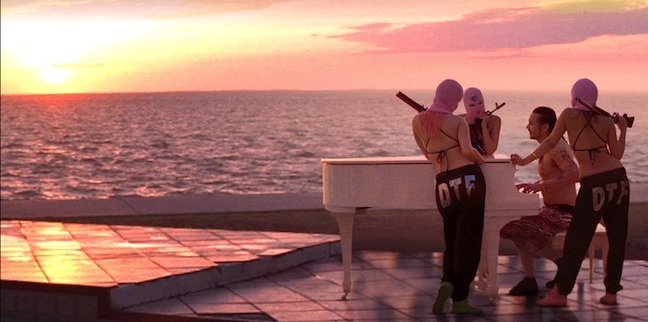
The way the film dealt with imagery was pretty incredible. For lack of a better word, I’d describe the film’s visual track as “fractured,” organized loosely by the dialogue accompanying it. In other words, the dialogue acts as a through-line around which the images are organized, but only vaguely, like an ever-shifting kaleidoscope. The visuals skip short distances forward and backward through time, illustrating and orbiting around the dialogue or evoking the setting’s atmosphere, sometimes repeating moments for emphasis. Accordingly, very rarely are the characters actually shown speaking their dialogue; instead, a wide array of images show the speakers or their subject(s) engaged in various, emblematic actions. This visual looseness allows for a fair degree audio freedom; in fact, quite often individual lines of dialogue or brief exchanges are repeated with variations, such as different intonations, or different accompanying imagery. At least once the characters are actually shown having the same exchange twice, but with different staging (as in the exchange near the end of the film about whether or not the characters fear their upcoming assault on a gangster’s mansion). These aesthetic choices result the film being shot through with a quasi-dream-like, free-floating looseness.
This stylistic looseness matches the looseness of the plot. The four female protagonists have only the most minimal of goals – get to Florida for spring break – which are quickly met. The film meanders from there through a loose string of coincidences and entirely new conflicts and characters, fitting for a film committed to indulging the hedonistic, consequence-free worldview of its characters.
Also remarkable are the characters, simply because they are almost non-existent (James Franco's "Alien" excluded). Of the four female protagonists, only one, Faith, receives strong distinguishing traits (she’s the religious “good” girl), and she leaves halfway through the film. The other three are practically ciphers; one (Cotty) is distinguished by her pink hair, but she also leaves two-thirds of the way through the film, and is given a nearly identical sendoff as Faith (right down to the staging and framing). The two that remain to the end (Brit and Candy) are practically indistinguishable from one another (I even had to look up Brit's name after seeing the film). However, despite their nearly complete lack of individualistic character traits, these two are in many respects the most interesting, since the collectively, the traits they do display are so refreshing. All four love to party, get drunk, do drugs, flirt with (and presumably screw) guys, but Brit and Candy have a particularly empowered attitude toward their affairs. They are the two who do the violent and scary work of stealing money from a restaurant in order to enable their spring break bacchanal in the first place. As interesting as the scene of their theft is (we see it play out twice, once from outside the restaurant, and one form inside - the second is far more brutal), their empowerment shines most clearly in one of the scenes they share with Alien.
After meeting them, Alien eventually takes them back to his oceanside house, and impresses them with all of the things he has (amongst them: knives, drugs, stacks of cash on a bed, shurikens, two different kinds of cologne, and lots and lots of guns). It’s a funny scene – small things become big in a small man’s world – but it becomes magnificent when Brit and Candy, seemingly impressed with Alien’s bravado, seduce him, pick up his guns, and then shove them in his mouth, telling him they don’t need him, and that they can kill him and just take his stuff. Then, in an unexpected turn, Alien shows himself to be a somewhat open-minded gangster: he fellates the guns like they're Brit and Candy’s cocks, and tells them he thinks he’s fallen in love with them right then and there. Apparently, he’s found his soul-mates. They are his kindred spirits, just as gangster as he is, while at the same time just as fem as all of the other hedonistic spring breakers with which they party throughout the film. It's a sea change in the dynamics of their relationship, which is now one of equals, rather than one of a rooster and his hens.
Their new partnership is nicely conveyed in an inspired, slow motion montage sequence of a series of violent heists (accompanied to Britney Spears’s “Evertyime”), but is most marvelously evident in the film’s climax. Alien, Brit, and Candy – the latter two clad in only pink ski masks and string bikinis – assault the mansion of Alien’s
rival, Archie. Alien is shot to death almost immediately, but Brit and Candy aren’t phased. They don’t even look at one another to reconfirm their commitment to the assault, but simply continue on the warpath, decimating Archie’s gang and killing Archie in his bathtub. Only on their way out of the mansion do they pause to bid Alien goodbye, gently kissing him before running off into the night.
The way the film dealt with imagery was pretty incredible. For lack of a better word, I’d describe the film’s visual track as “fractured,” organized loosely by the dialogue accompanying it. In other words, the dialogue acts as a through-line around which the images are organized, but only vaguely, like an ever-shifting kaleidoscope. The visuals skip short distances forward and backward through time, illustrating and orbiting around the dialogue or evoking the setting’s atmosphere, sometimes repeating moments for emphasis. Accordingly, very rarely are the characters actually shown speaking their dialogue; instead, a wide array of images show the speakers or their subject(s) engaged in various, emblematic actions. This visual looseness allows for a fair degree audio freedom; in fact, quite often individual lines of dialogue or brief exchanges are repeated with variations, such as different intonations, or different accompanying imagery. At least once the characters are actually shown having the same exchange twice, but with different staging (as in the exchange near the end of the film about whether or not the characters fear their upcoming assault on a gangster’s mansion). These aesthetic choices result the film being shot through with a quasi-dream-like, free-floating looseness.
This stylistic looseness matches the looseness of the plot. The four female protagonists have only the most minimal of goals – get to Florida for spring break – which are quickly met. The film meanders from there through a loose string of coincidences and entirely new conflicts and characters, fitting for a film committed to indulging the hedonistic, consequence-free worldview of its characters.
Also remarkable are the characters, simply because they are almost non-existent (James Franco's "Alien" excluded). Of the four female protagonists, only one, Faith, receives strong distinguishing traits (she’s the religious “good” girl), and she leaves halfway through the film. The other three are practically ciphers; one (Cotty) is distinguished by her pink hair, but she also leaves two-thirds of the way through the film, and is given a nearly identical sendoff as Faith (right down to the staging and framing). The two that remain to the end (Brit and Candy) are practically indistinguishable from one another (I even had to look up Brit's name after seeing the film). However, despite their nearly complete lack of individualistic character traits, these two are in many respects the most interesting, since the collectively, the traits they do display are so refreshing. All four love to party, get drunk, do drugs, flirt with (and presumably screw) guys, but Brit and Candy have a particularly empowered attitude toward their affairs. They are the two who do the violent and scary work of stealing money from a restaurant in order to enable their spring break bacchanal in the first place. As interesting as the scene of their theft is (we see it play out twice, once from outside the restaurant, and one form inside - the second is far more brutal), their empowerment shines most clearly in one of the scenes they share with Alien.
After meeting them, Alien eventually takes them back to his oceanside house, and impresses them with all of the things he has (amongst them: knives, drugs, stacks of cash on a bed, shurikens, two different kinds of cologne, and lots and lots of guns). It’s a funny scene – small things become big in a small man’s world – but it becomes magnificent when Brit and Candy, seemingly impressed with Alien’s bravado, seduce him, pick up his guns, and then shove them in his mouth, telling him they don’t need him, and that they can kill him and just take his stuff. Then, in an unexpected turn, Alien shows himself to be a somewhat open-minded gangster: he fellates the guns like they're Brit and Candy’s cocks, and tells them he thinks he’s fallen in love with them right then and there. Apparently, he’s found his soul-mates. They are his kindred spirits, just as gangster as he is, while at the same time just as fem as all of the other hedonistic spring breakers with which they party throughout the film. It's a sea change in the dynamics of their relationship, which is now one of equals, rather than one of a rooster and his hens.
Their new partnership is nicely conveyed in an inspired, slow motion montage sequence of a series of violent heists (accompanied to Britney Spears’s “Evertyime”), but is most marvelously evident in the film’s climax. Alien, Brit, and Candy – the latter two clad in only pink ski masks and string bikinis – assault the mansion of Alien’s
rival, Archie. Alien is shot to death almost immediately, but Brit and Candy aren’t phased. They don’t even look at one another to reconfirm their commitment to the assault, but simply continue on the warpath, decimating Archie’s gang and killing Archie in his bathtub. Only on their way out of the mansion do they pause to bid Alien goodbye, gently kissing him before running off into the night.
Monday, April 22, 2013
Mad Men Season 6, Episode 4: “To Have and to Hold”
Monday, April 15, 2013
Mad Men Season 6, Episode 3: “Collaborators”
As expected, this week spends a lot of time focusing on Pete, who continues the trend from last season of becoming a poor man’s Don Draper on an accelerated timescale. Like Don, he’s grown restless in his marriage to a beautiful woman and life in the suburbs.* Like Don, he’s tried his hand at a string of affairs with other women, and now, like Don, he’s decided to start sleeping with his neighbor’s wife, Brenda (in showing how foolish such a liaison turns out to be, perhaps this is a way of the show hinting at later season developments for Don and Sylvia). Pete even has the same corner office on the second floor of SCDP as Don has on the first floor (and with the furniture arranged in the picturesque way the photographers wanted Don’s furniture arranged in the premiere – Pete’s never happy, but at least he’ll maintain the image of being happy). Tuesday, April 9, 2013
Mad Men Season 6, Episodes 1 and 2, "The Doorway"
Monday, March 4, 2013
Girls Season 2, Episode 8, “It’s Back”
For a show entitled Girls, it’s probably bad form to be so fascinated with a male character rather than a female character, but I cannot help myself. Adam Driver’s performance as Adam is a wonder – his line readings are unlike anything I’ve seen elsewhere, and seem to me to give great depth to what might otherwise be a shallow part. Somehow, through a combination of his cadence, his intonation, his volume and his gestures, when he speaks it’s as if I can see through his words to the many unexpressed thoughts beneath them, as if each line of dialogue is the precarious outcome of a tumult of conflicting instincts, intuitions, and thoughts. Usually, his halting cadence makes it seem as though he’s constantly stopping himself from saying more, and bottling up what he’s thinking – which obviously isn’t the case, because he frequently acts as if the outrageous things he says and does are rather ordinary things for people to say and do.
That’s what makes his outburst in the AA meeting of last night’s episode such a treat. It’s rare to have such unbridled insight into what makes this guy tick, especially when it’s so excellently written. He treats this AA group like therapy, unburdening himself of all of his frustration, confusion, and depression over his and Hannah’s breakup. It’s a raw monologue that just flows out of him, making him appear vulnerable and introspective, and in touch with himself. Particularly excellent writing included the bit where he talked about how wanted to teach her things she didn’t know (like how to use soap or what street Central Park started on). I thought it nicely representative of wanting to share things in your life with someone you love. I can’t blame Carol Kane for wanting to set up her daughter with him – based on that display, I’d want my hypothetical daughter to meet him too.
His monologue at the AA meeting was Adam’s showcase moment from this episode, but he had other excellent moments throughout. His phone call to Natalia was particularly well-acted. As his message got more awkward, he put himself in increasingly awkward physical positions: bending over, climbing a ladder, and then putting his head between the steps. And after hanging up, he instantly becomes disgusted with some of the things he says (specifically, describing himself as a creep), something everyone’s done at some point in their lives after talking on the phone with a potential love interest.
Adam and Natalia’s meeting provided more goodies. I loved the way in which it took him a moment to register that the beautiful woman walking through the door was there to see him – as if never in a million years did he think that Carol Kane’s daughter would be this person. Their mutual reactions to each other were also a delight. Adam is his usual, unfiltered self (“Holy shit!”), while Natalia says, “Oh my god, I love my mom.” The scene was great for vicarious living, indulging everyone’s fantasy of instantaneously hitting it off with a beautiful person.
Of course, the actual girls on Girls are pretty great as well. It’s as if each of the characters is in competition to be the least self-aware character on the show. For my money, Marnie is in the lead, followed closely by Hannah and Jessa, with Shoshana a distant fourth. Marnie’s self-esteem has always been wrapped up in how she compares herself with the other characters, especially her ex-boyfriend Charlie, but also the other regulars. It’s one her most unpleasant characteristics, and one of the reasons she seems like a real character (something I think is true of most of the characters on this show – their unsympathetic traits are a part of what make them seem so well-rounded). Naturally, she finds it difficult to see Charlie so successful while she’s currently in limbo as a hostess (I thought it an especially nice touch that she had her hair in childish-looking tails when she sees Charlie – quite a contrast from his put-together, office-casual appearance).
In another nice touch, Charlie finally seems to have figured out that Marnie is rather toxic for him: after stopping by his new office and telling him she's there for support, he sarcastically mutters, “Yeah, from me or for me?” Apparently, her toxicity is something he figured out a while ago: the app he sold to get the nice job he currently enjoys was predicated on his wanting to call her but knowing he shouldn’t. It’s called “Forbid,” and it’s free to download, but charges you $10 to call a person you designate to the software. In his case, he devised it to prevent himself from calling Marnie after their breakup. However, true to form, Marnie is oblivious to the obvious, and has to be told explicitly that she’s the reason he created the program in the first place (it’s possible that she knows she’s the reason why he created the app and just wants to hear him say it, although I think her reaction to the news – she thinks it is weird – favors the former inference more than the latter).
In another nice touch, Charlie finally seems to be equipped to deal with Marnie’s parasitic self-esteem issues. When Marnie fishes for details about how much Charlie got paid for the app (the better to finely adjust her self-esteem), Charlie strings her along, and they go back and forth in screwball comedy cadence:
Charlie: They paid me a shitload.
Marnie: Good.
Charlie: No, it’s not that much.
Marnie: Oh.
Charlie: But it’s enough.
Marnie: Good.
Charlie: Yup.
Then, to top it off, he asks a demoralizing question: “Do you need money? Is that why you’re here?” It’s a strange situation in which a supposedly benevolent question is actually rather malicious, but given the way Marnie has treated him in the past, it’s well-deserved.
Meanwhile, the pressure of the deadline for her book deal causes Hannah to suffer a recurrence (apparently) of her OCD. I like that the writers have created consequences of the pressure Hannah is feeling, but I’m not terribly thrilled with this development. On the one hand, it led to a nice scene between her and a therapist, where she angrily describes how crippling the OCD has been for her in the past.* On the other hand, if her OCD was indeed so severe, it doesn’t seem to me like this would be the first time we’ve heard of it. Hannah is so quick to talk about her personal issues with anyone that it seems like this is something she would have raised at some point in the past (I can envision it now: she raises it as an example of the struggles she’s gone through in an attempt to win points in an argument over her behavior. Or she raises it as an instance of what an interesting person – and therefore good writer – she is). Perhaps it isn’t something that would have come up over the course of the first season, but it felt a bit like lazy, retroactive continuity.
* I liked Hannah’s outburst both for its dramatic weight, but also because it’s typically Hannah – her anger is a product of the therapist suggesting her OCD is “classical,” as if he is categorizing her pain as no different from that of others who suffer from her disorder. Now, this might be upsetting for a lot of people, but Hannah’s particular brand of self-unawareness is her insistence that her experiences and thoughts are more powerful because they happen to her. Everything that happens to her is lived more fully than when it happens to others (even though really, she just likes to talk about it more). As Alan Sepinwall wrote in his review of the bottle episode a few weeks ago, “Hannah's pain still has to be more interesting and special than everyone else's.” Thus her anger at her therapist is slightly less sympathetic than it would be otherwise. Although, as Sepinwall insightfully points out in his review of this week's episode, her need for her experiences to be special is in part a way for her to cope with her previous powerlessness over her OCD.
Other thoughts:
- I like that Adam keeps a bottle of milk by his bedside table for so long that it curdles, yet he doesn’t think to check the milk before drinking it.
- At first, I thought Hannah’s checking over her shoulder after Adam called was her looking to see if he was stalking her, rather than a manifestation of a previously unrevealed struggle with OCD.
- Ray is a source of constant amusement. Like him, I also winced when Shoshana’s friend referred to her roller blades as “vintage.”
- I loved Marnie’s face as she assessed the attractive blonde Charlie consults with briefly in his office, and then the false smile Marnie gives Charlie when he turns back to face her. Rarely is her insecurity so baldly on display, but given where she is in her life at the moment, it works.
- Not only is Natalia beautiful, she’s also fascinating: she works with a private eye, sometimes as a decoy for his subterfuge. A real-life femme fatale!
- More hilarious honesty from Adam: “You’re very easy to talk to. I thought this was going to suck ass, but you’re very easy to talk to.” He then goes on to say he’s sweating bullets and that he’s had to pee for the past thirty minutes. And she finds this charming! Be still, my beating heart.
- Adam uses AA for therapy, while Hannah is forced to go to see an actual therapist. Some nice symmetry there.
- Poor Shoshana. Her behavior with the doorman upon leaving the party makes me wonder if she’ll ever realize that she may be happier if she isn’t so concerned with what others think of her (perhaps this is her arc for the series). As soon as she registers that the doorman is interested in her, an affected, unconvincing air of attempted coolness washes over her as she tries to conform to what the doorman might want. At least she throws her neuroses out the window long enough to hook up with him.
- Marnie “mentally budgeted six years of brokenness” for Charlie after their breakup. It’s ambiguous whether or not she means she intended for him to be broken for that long, or if that was just an estimation she made based on his behavior. Ugh.
- Marnie sums up her lack of self-awareness quite nicely in her outburst with Ray. Standing in her demeaning hostess uniform, she tells Ray, “It doesn’t matter how right you do things. You know who will end up living their dreams? Sad messes like Charlie! And the people who end up flailing behind are people like me! Who have their shit together!” (Loved Ray’s deadpan response: “Marnie learns another life lesson. How adorable.”) Kudos to Ray, though: despite his previously stated disdain for Marnie, he tries to get her to realize she should stop judging herself against others, and just focus on doing what she wants to do (which is singing, hilariously enough).
- Really, I would be happy with an entire episode of Marnie and Ray interacting. Ray tries to impress upon Marnie the urgency of her following her dreams of singing by telling her, “You’re never going to look this good again.” To which she sadly responds, “Thank you.”
Update: Apparently, seeds of Hannah's OCD have been planted in the past, but I just forgot about them or didn't notice them. See Sepinwall's review.
That’s what makes his outburst in the AA meeting of last night’s episode such a treat. It’s rare to have such unbridled insight into what makes this guy tick, especially when it’s so excellently written. He treats this AA group like therapy, unburdening himself of all of his frustration, confusion, and depression over his and Hannah’s breakup. It’s a raw monologue that just flows out of him, making him appear vulnerable and introspective, and in touch with himself. Particularly excellent writing included the bit where he talked about how wanted to teach her things she didn’t know (like how to use soap or what street Central Park started on). I thought it nicely representative of wanting to share things in your life with someone you love. I can’t blame Carol Kane for wanting to set up her daughter with him – based on that display, I’d want my hypothetical daughter to meet him too.
His monologue at the AA meeting was Adam’s showcase moment from this episode, but he had other excellent moments throughout. His phone call to Natalia was particularly well-acted. As his message got more awkward, he put himself in increasingly awkward physical positions: bending over, climbing a ladder, and then putting his head between the steps. And after hanging up, he instantly becomes disgusted with some of the things he says (specifically, describing himself as a creep), something everyone’s done at some point in their lives after talking on the phone with a potential love interest.
Adam and Natalia’s meeting provided more goodies. I loved the way in which it took him a moment to register that the beautiful woman walking through the door was there to see him – as if never in a million years did he think that Carol Kane’s daughter would be this person. Their mutual reactions to each other were also a delight. Adam is his usual, unfiltered self (“Holy shit!”), while Natalia says, “Oh my god, I love my mom.” The scene was great for vicarious living, indulging everyone’s fantasy of instantaneously hitting it off with a beautiful person.
Of course, the actual girls on Girls are pretty great as well. It’s as if each of the characters is in competition to be the least self-aware character on the show. For my money, Marnie is in the lead, followed closely by Hannah and Jessa, with Shoshana a distant fourth. Marnie’s self-esteem has always been wrapped up in how she compares herself with the other characters, especially her ex-boyfriend Charlie, but also the other regulars. It’s one her most unpleasant characteristics, and one of the reasons she seems like a real character (something I think is true of most of the characters on this show – their unsympathetic traits are a part of what make them seem so well-rounded). Naturally, she finds it difficult to see Charlie so successful while she’s currently in limbo as a hostess (I thought it an especially nice touch that she had her hair in childish-looking tails when she sees Charlie – quite a contrast from his put-together, office-casual appearance).
In another nice touch, Charlie finally seems to have figured out that Marnie is rather toxic for him: after stopping by his new office and telling him she's there for support, he sarcastically mutters, “Yeah, from me or for me?” Apparently, her toxicity is something he figured out a while ago: the app he sold to get the nice job he currently enjoys was predicated on his wanting to call her but knowing he shouldn’t. It’s called “Forbid,” and it’s free to download, but charges you $10 to call a person you designate to the software. In his case, he devised it to prevent himself from calling Marnie after their breakup. However, true to form, Marnie is oblivious to the obvious, and has to be told explicitly that she’s the reason he created the program in the first place (it’s possible that she knows she’s the reason why he created the app and just wants to hear him say it, although I think her reaction to the news – she thinks it is weird – favors the former inference more than the latter).
In another nice touch, Charlie finally seems to be equipped to deal with Marnie’s parasitic self-esteem issues. When Marnie fishes for details about how much Charlie got paid for the app (the better to finely adjust her self-esteem), Charlie strings her along, and they go back and forth in screwball comedy cadence:
Charlie: They paid me a shitload.
Marnie: Good.
Charlie: No, it’s not that much.
Marnie: Oh.
Charlie: But it’s enough.
Marnie: Good.
Charlie: Yup.
Then, to top it off, he asks a demoralizing question: “Do you need money? Is that why you’re here?” It’s a strange situation in which a supposedly benevolent question is actually rather malicious, but given the way Marnie has treated him in the past, it’s well-deserved.
Meanwhile, the pressure of the deadline for her book deal causes Hannah to suffer a recurrence (apparently) of her OCD. I like that the writers have created consequences of the pressure Hannah is feeling, but I’m not terribly thrilled with this development. On the one hand, it led to a nice scene between her and a therapist, where she angrily describes how crippling the OCD has been for her in the past.* On the other hand, if her OCD was indeed so severe, it doesn’t seem to me like this would be the first time we’ve heard of it. Hannah is so quick to talk about her personal issues with anyone that it seems like this is something she would have raised at some point in the past (I can envision it now: she raises it as an example of the struggles she’s gone through in an attempt to win points in an argument over her behavior. Or she raises it as an instance of what an interesting person – and therefore good writer – she is). Perhaps it isn’t something that would have come up over the course of the first season, but it felt a bit like lazy, retroactive continuity.
* I liked Hannah’s outburst both for its dramatic weight, but also because it’s typically Hannah – her anger is a product of the therapist suggesting her OCD is “classical,” as if he is categorizing her pain as no different from that of others who suffer from her disorder. Now, this might be upsetting for a lot of people, but Hannah’s particular brand of self-unawareness is her insistence that her experiences and thoughts are more powerful because they happen to her. Everything that happens to her is lived more fully than when it happens to others (even though really, she just likes to talk about it more). As Alan Sepinwall wrote in his review of the bottle episode a few weeks ago, “Hannah's pain still has to be more interesting and special than everyone else's.” Thus her anger at her therapist is slightly less sympathetic than it would be otherwise. Although, as Sepinwall insightfully points out in his review of this week's episode, her need for her experiences to be special is in part a way for her to cope with her previous powerlessness over her OCD.
Other thoughts:
- I like that Adam keeps a bottle of milk by his bedside table for so long that it curdles, yet he doesn’t think to check the milk before drinking it.
- At first, I thought Hannah’s checking over her shoulder after Adam called was her looking to see if he was stalking her, rather than a manifestation of a previously unrevealed struggle with OCD.
- Ray is a source of constant amusement. Like him, I also winced when Shoshana’s friend referred to her roller blades as “vintage.”
- I loved Marnie’s face as she assessed the attractive blonde Charlie consults with briefly in his office, and then the false smile Marnie gives Charlie when he turns back to face her. Rarely is her insecurity so baldly on display, but given where she is in her life at the moment, it works.
- Not only is Natalia beautiful, she’s also fascinating: she works with a private eye, sometimes as a decoy for his subterfuge. A real-life femme fatale!
- More hilarious honesty from Adam: “You’re very easy to talk to. I thought this was going to suck ass, but you’re very easy to talk to.” He then goes on to say he’s sweating bullets and that he’s had to pee for the past thirty minutes. And she finds this charming! Be still, my beating heart.
- Adam uses AA for therapy, while Hannah is forced to go to see an actual therapist. Some nice symmetry there.
- Poor Shoshana. Her behavior with the doorman upon leaving the party makes me wonder if she’ll ever realize that she may be happier if she isn’t so concerned with what others think of her (perhaps this is her arc for the series). As soon as she registers that the doorman is interested in her, an affected, unconvincing air of attempted coolness washes over her as she tries to conform to what the doorman might want. At least she throws her neuroses out the window long enough to hook up with him.
- Marnie “mentally budgeted six years of brokenness” for Charlie after their breakup. It’s ambiguous whether or not she means she intended for him to be broken for that long, or if that was just an estimation she made based on his behavior. Ugh.
- Marnie sums up her lack of self-awareness quite nicely in her outburst with Ray. Standing in her demeaning hostess uniform, she tells Ray, “It doesn’t matter how right you do things. You know who will end up living their dreams? Sad messes like Charlie! And the people who end up flailing behind are people like me! Who have their shit together!” (Loved Ray’s deadpan response: “Marnie learns another life lesson. How adorable.”) Kudos to Ray, though: despite his previously stated disdain for Marnie, he tries to get her to realize she should stop judging herself against others, and just focus on doing what she wants to do (which is singing, hilariously enough).
- Really, I would be happy with an entire episode of Marnie and Ray interacting. Ray tries to impress upon Marnie the urgency of her following her dreams of singing by telling her, “You’re never going to look this good again.” To which she sadly responds, “Thank you.”
Update: Apparently, seeds of Hannah's OCD have been planted in the past, but I just forgot about them or didn't notice them. See Sepinwall's review.
Subscribe to:
Posts (Atom)