This week’s episode deals with the impact of Martin Luther King Jr.’s assassination, and how tragedy supposedly brings people closer together. Ginsburg’s father spells out this idea most clearly when he chastises his son for not using King’s death as an opportunity to bond more closely with the date his father set him up with, citing the biblical flood as a precedent. It’s a theme that plays out in various ways over the course of the episode, although in many cases, Mad Men’s damaged characters can’t quite bridge the gap between themselves and others, and in some cases they find themselves driven further apart. Peggy, for instance, is on the verge of moving into a new apartment with Abe, but when news of the tragedy hits, Abe leaves Peggy and rushes off to Harlem to write an article for The New York Times on the civil unrest there. Later, consumed by the story, he reveals that he never wanted to live on the Upper East Side. Similarly, Betty has to watch Henry rush over to Harlem to lend his supporting in the quelling of the discontent there. Other examples abound: Pete reaches out to Trudy, but this tragedy isn’t enough to bridge the gulf between them. Joan gives Dawn an incredibly awkward, unwanted, and unreciprocated hug. Don has no means of reaching Sylvia, who is away in DC. Pete and Harry have a moment of commiseration before Pete realizes that Harry is really only upset about how King’s death has screwed up SCDP’s television commercial billings because of all of the preempted programming. Pete might be grating most of the time, but he’s always been one of the most politically progressive characters on the show, and that trait shines through in the scene where he unloads on Harry over his crassness (it feels slightly odd every time the show puts me in the position of rooting for Pete, but here it felt rather vindicating, especially in the context of Harry’s self-righteousness last week).
Monday, April 29, 2013
Spring Breakers

Some brief thoughts on the fascinating Spring Breakers:
The way the film dealt with imagery was pretty incredible. For lack of a better word, I’d describe the film’s visual track as “fractured,” organized loosely by the dialogue accompanying it. In other words, the dialogue acts as a through-line around which the images are organized, but only vaguely, like an ever-shifting kaleidoscope. The visuals skip short distances forward and backward through time, illustrating and orbiting around the dialogue or evoking the setting’s atmosphere, sometimes repeating moments for emphasis. Accordingly, very rarely are the characters actually shown speaking their dialogue; instead, a wide array of images show the speakers or their subject(s) engaged in various, emblematic actions. This visual looseness allows for a fair degree audio freedom; in fact, quite often individual lines of dialogue or brief exchanges are repeated with variations, such as different intonations, or different accompanying imagery. At least once the characters are actually shown having the same exchange twice, but with different staging (as in the exchange near the end of the film about whether or not the characters fear their upcoming assault on a gangster’s mansion). These aesthetic choices result the film being shot through with a quasi-dream-like, free-floating looseness.
This stylistic looseness matches the looseness of the plot. The four female protagonists have only the most minimal of goals – get to Florida for spring break – which are quickly met. The film meanders from there through a loose string of coincidences and entirely new conflicts and characters, fitting for a film committed to indulging the hedonistic, consequence-free worldview of its characters.
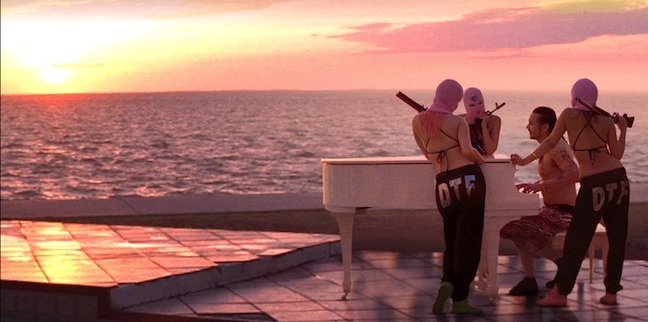
Also remarkable are the characters, simply because they are almost non-existent (James Franco's "Alien" excluded). Of the four female protagonists, only one, Faith, receives strong distinguishing traits (she’s the religious “good” girl), and she leaves halfway through the film. The other three are practically ciphers; one (Cotty) is distinguished by her pink hair, but she also leaves two-thirds of the way through the film, and is given a nearly identical sendoff as Faith (right down to the staging and framing). The two that remain to the end (Brit and Candy) are practically indistinguishable from one another (I even had to look up Brit's name after seeing the film). However, despite their nearly complete lack of individualistic character traits, these two are in many respects the most interesting, since the collectively, the traits they do display are so refreshing. All four love to party, get drunk, do drugs, flirt with (and presumably screw) guys, but Brit and Candy have a particularly empowered attitude toward their affairs. They are the two who do the violent and scary work of stealing money from a restaurant in order to enable their spring break bacchanal in the first place. As interesting as the scene of their theft is (we see it play out twice, once from outside the restaurant, and one form inside - the second is far more brutal), their empowerment shines most clearly in one of the scenes they share with Alien.
After meeting them, Alien eventually takes them back to his oceanside house, and impresses them with all of the things he has (amongst them: knives, drugs, stacks of cash on a bed, shurikens, two different kinds of cologne, and lots and lots of guns). It’s a funny scene – small things become big in a small man’s world – but it becomes magnificent when Brit and Candy, seemingly impressed with Alien’s bravado, seduce him, pick up his guns, and then shove them in his mouth, telling him they don’t need him, and that they can kill him and just take his stuff. Then, in an unexpected turn, Alien shows himself to be a somewhat open-minded gangster: he fellates the guns like they're Brit and Candy’s cocks, and tells them he thinks he’s fallen in love with them right then and there. Apparently, he’s found his soul-mates. They are his kindred spirits, just as gangster as he is, while at the same time just as fem as all of the other hedonistic spring breakers with which they party throughout the film. It's a sea change in the dynamics of their relationship, which is now one of equals, rather than one of a rooster and his hens.
Their new partnership is nicely conveyed in an inspired, slow motion montage sequence of a series of violent heists (accompanied to Britney Spears’s “Evertyime”), but is most marvelously evident in the film’s climax. Alien, Brit, and Candy – the latter two clad in only pink ski masks and string bikinis – assault the mansion of Alien’s
rival, Archie. Alien is shot to death almost immediately, but Brit and Candy aren’t phased. They don’t even look at one another to reconfirm their commitment to the assault, but simply continue on the warpath, decimating Archie’s gang and killing Archie in his bathtub. Only on their way out of the mansion do they pause to bid Alien goodbye, gently kissing him before running off into the night.
The way the film dealt with imagery was pretty incredible. For lack of a better word, I’d describe the film’s visual track as “fractured,” organized loosely by the dialogue accompanying it. In other words, the dialogue acts as a through-line around which the images are organized, but only vaguely, like an ever-shifting kaleidoscope. The visuals skip short distances forward and backward through time, illustrating and orbiting around the dialogue or evoking the setting’s atmosphere, sometimes repeating moments for emphasis. Accordingly, very rarely are the characters actually shown speaking their dialogue; instead, a wide array of images show the speakers or their subject(s) engaged in various, emblematic actions. This visual looseness allows for a fair degree audio freedom; in fact, quite often individual lines of dialogue or brief exchanges are repeated with variations, such as different intonations, or different accompanying imagery. At least once the characters are actually shown having the same exchange twice, but with different staging (as in the exchange near the end of the film about whether or not the characters fear their upcoming assault on a gangster’s mansion). These aesthetic choices result the film being shot through with a quasi-dream-like, free-floating looseness.
This stylistic looseness matches the looseness of the plot. The four female protagonists have only the most minimal of goals – get to Florida for spring break – which are quickly met. The film meanders from there through a loose string of coincidences and entirely new conflicts and characters, fitting for a film committed to indulging the hedonistic, consequence-free worldview of its characters.
Also remarkable are the characters, simply because they are almost non-existent (James Franco's "Alien" excluded). Of the four female protagonists, only one, Faith, receives strong distinguishing traits (she’s the religious “good” girl), and she leaves halfway through the film. The other three are practically ciphers; one (Cotty) is distinguished by her pink hair, but she also leaves two-thirds of the way through the film, and is given a nearly identical sendoff as Faith (right down to the staging and framing). The two that remain to the end (Brit and Candy) are practically indistinguishable from one another (I even had to look up Brit's name after seeing the film). However, despite their nearly complete lack of individualistic character traits, these two are in many respects the most interesting, since the collectively, the traits they do display are so refreshing. All four love to party, get drunk, do drugs, flirt with (and presumably screw) guys, but Brit and Candy have a particularly empowered attitude toward their affairs. They are the two who do the violent and scary work of stealing money from a restaurant in order to enable their spring break bacchanal in the first place. As interesting as the scene of their theft is (we see it play out twice, once from outside the restaurant, and one form inside - the second is far more brutal), their empowerment shines most clearly in one of the scenes they share with Alien.
After meeting them, Alien eventually takes them back to his oceanside house, and impresses them with all of the things he has (amongst them: knives, drugs, stacks of cash on a bed, shurikens, two different kinds of cologne, and lots and lots of guns). It’s a funny scene – small things become big in a small man’s world – but it becomes magnificent when Brit and Candy, seemingly impressed with Alien’s bravado, seduce him, pick up his guns, and then shove them in his mouth, telling him they don’t need him, and that they can kill him and just take his stuff. Then, in an unexpected turn, Alien shows himself to be a somewhat open-minded gangster: he fellates the guns like they're Brit and Candy’s cocks, and tells them he thinks he’s fallen in love with them right then and there. Apparently, he’s found his soul-mates. They are his kindred spirits, just as gangster as he is, while at the same time just as fem as all of the other hedonistic spring breakers with which they party throughout the film. It's a sea change in the dynamics of their relationship, which is now one of equals, rather than one of a rooster and his hens.
Their new partnership is nicely conveyed in an inspired, slow motion montage sequence of a series of violent heists (accompanied to Britney Spears’s “Evertyime”), but is most marvelously evident in the film’s climax. Alien, Brit, and Candy – the latter two clad in only pink ski masks and string bikinis – assault the mansion of Alien’s
rival, Archie. Alien is shot to death almost immediately, but Brit and Candy aren’t phased. They don’t even look at one another to reconfirm their commitment to the assault, but simply continue on the warpath, decimating Archie’s gang and killing Archie in his bathtub. Only on their way out of the mansion do they pause to bid Alien goodbye, gently kissing him before running off into the night.
Monday, April 22, 2013
Mad Men Season 6, Episode 4: “To Have and to Hold”
Monday, April 15, 2013
Mad Men Season 6, Episode 3: “Collaborators”
As expected, this week spends a lot of time focusing on Pete, who continues the trend from last season of becoming a poor man’s Don Draper on an accelerated timescale. Like Don, he’s grown restless in his marriage to a beautiful woman and life in the suburbs.* Like Don, he’s tried his hand at a string of affairs with other women, and now, like Don, he’s decided to start sleeping with his neighbor’s wife, Brenda (in showing how foolish such a liaison turns out to be, perhaps this is a way of the show hinting at later season developments for Don and Sylvia). Pete even has the same corner office on the second floor of SCDP as Don has on the first floor (and with the furniture arranged in the picturesque way the photographers wanted Don’s furniture arranged in the premiere – Pete’s never happy, but at least he’ll maintain the image of being happy). Tuesday, April 9, 2013
Mad Men Season 6, Episodes 1 and 2, "The Doorway"
Subscribe to:
Posts (Atom)

