Some brief thoughts on the fascinating Spring Breakers:
The way the film dealt with imagery was pretty incredible. For lack of a better word, I’d describe the film’s visual track as “fractured,” organized loosely by the dialogue accompanying it. In other words, the dialogue acts as a through-line around which the images are organized, but only vaguely, like an ever-shifting kaleidoscope. The visuals skip short distances forward and backward through time, illustrating and orbiting around the dialogue or evoking the setting’s atmosphere, sometimes repeating moments for emphasis. Accordingly, very rarely are the characters actually shown speaking their dialogue; instead, a wide array of images show the speakers or their subject(s) engaged in various, emblematic actions. This visual looseness allows for a fair degree audio freedom; in fact, quite often individual lines of dialogue or brief exchanges are repeated with variations, such as different intonations, or different accompanying imagery. At least once the characters are actually shown having the same exchange twice, but with different staging (as in the exchange near the end of the film about whether or not the characters fear their upcoming assault on a gangster’s mansion). These aesthetic choices result the film being shot through with a quasi-dream-like, free-floating looseness.
This stylistic looseness matches the looseness of the plot. The four female protagonists have only the most minimal of goals – get to Florida for spring break – which are quickly met. The film meanders from there through a loose string of coincidences and entirely new conflicts and characters, fitting for a film committed to indulging the hedonistic, consequence-free worldview of its characters.
Also remarkable are the characters, simply because they are almost non-existent (James Franco's "Alien" excluded). Of the four female protagonists, only one, Faith, receives strong distinguishing traits (she’s the religious “good” girl), and she leaves halfway through the film. The other three are practically ciphers; one (Cotty) is distinguished by her pink hair, but she also leaves two-thirds of the way through the film, and is given a nearly identical sendoff as Faith (right down to the staging and framing). The two that remain to the end (Brit and Candy) are practically indistinguishable from one another (I even had to look up Brit's name after seeing the film). However, despite their nearly complete lack of individualistic character traits, these two are in many respects the most interesting, since the collectively, the traits they do display are so refreshing. All four love to party, get drunk, do drugs, flirt with (and presumably screw) guys, but Brit and Candy have a particularly empowered attitude toward their affairs. They are the two who do the violent and scary work of stealing money from a restaurant in order to enable their spring break bacchanal in the first place. As interesting as the scene of their theft is (we see it play out twice, once from outside the restaurant, and one form inside - the second is far more brutal), their empowerment shines most clearly in one of the scenes they share with Alien.
After meeting them, Alien eventually takes them back to his oceanside house, and impresses them with all of the things he has (amongst them: knives, drugs, stacks of cash on a bed, shurikens, two different kinds of cologne, and lots and lots of guns). It’s a funny scene – small things become big in a small man’s world – but it becomes magnificent when Brit and Candy, seemingly impressed with Alien’s bravado, seduce him, pick up his guns, and then shove them in his mouth, telling him they don’t need him, and that they can kill him and just take his stuff. Then, in an unexpected turn, Alien shows himself to be a somewhat open-minded gangster: he fellates the guns like they're Brit and Candy’s cocks, and tells them he thinks he’s fallen in love with them right then and there. Apparently, he’s found his soul-mates. They are his kindred spirits, just as gangster as he is, while at the same time just as fem as all of the other hedonistic spring breakers with which they party throughout the film. It's a sea change in the dynamics of their relationship, which is now one of equals, rather than one of a rooster and his hens.
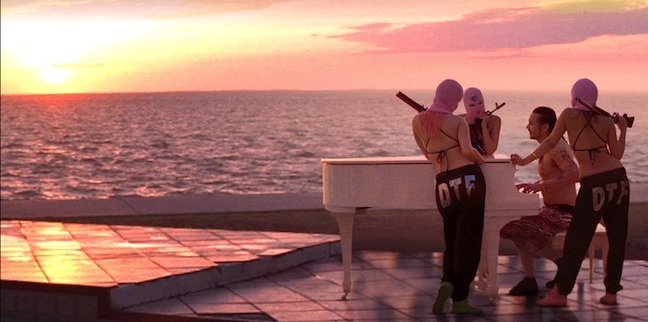
Their new partnership is nicely conveyed in an inspired, slow motion montage sequence of a series of violent heists (accompanied to Britney Spears’s “Evertyime”), but is most marvelously evident in the film’s climax. Alien, Brit, and Candy – the latter two clad in only pink ski masks and string bikinis – assault the mansion of Alien’s
rival, Archie. Alien is shot to death almost immediately, but Brit and Candy aren’t phased. They don’t even look at one another to reconfirm their commitment to the assault, but simply continue on the warpath, decimating Archie’s gang and killing Archie in his bathtub. Only on their way out of the mansion do they pause to bid Alien goodbye, gently kissing him before running off into the night.
Monday, April 29, 2013
Monday, April 22, 2013
Mad Men Season 6, Episode 4: “To Have and to Hold”
Monday, April 15, 2013
Mad Men Season 6, Episode 3: “Collaborators”
As expected, this week spends a lot of time focusing on Pete, who continues the trend from last season of becoming a poor man’s Don Draper on an accelerated timescale. Like Don, he’s grown restless in his marriage to a beautiful woman and life in the suburbs.* Like Don, he’s tried his hand at a string of affairs with other women, and now, like Don, he’s decided to start sleeping with his neighbor’s wife, Brenda (in showing how foolish such a liaison turns out to be, perhaps this is a way of the show hinting at later season developments for Don and Sylvia). Pete even has the same corner office on the second floor of SCDP as Don has on the first floor (and with the furniture arranged in the picturesque way the photographers wanted Don’s furniture arranged in the premiere – Pete’s never happy, but at least he’ll maintain the image of being happy). Tuesday, April 9, 2013
Mad Men Season 6, Episodes 1 and 2, "The Doorway"
Any doubts about the return of the old Don are permanently dispelled at the episode’s conclusion, when we see him involved in his latest extramarital affair, this time with Sylvia, the wife of his neighbor, Dr. Arnie Rosen (and the person who recommended Don read Dante in the first place).* The concern over Don’s identity is again driven home midway through this double-sized episode (and what will serve as the end of the first episode when it is split in two for syndication). Don is posing for a publicity photographer when he realizes he accidentally switched army-issued lighters with PFC Dinkins, and concern washes over his face: he’s lost one of the totems of his Don Draper identity. His concern is compounded when the photographer, in an effort to capture a candid pose, tells Don to just be himself. Don’s disquiet here is over his newfound knowledge of exactly what that means. * Although to be fair, the episode does hint at a change in Don here, but a relatively minor one. Sylvia asks Don what he wants for the new year, and Don halfheartedly responds, “I want to stop doing this.” Her reply is a sympathetic, “I know.” Perhaps Don can’t stop himself from cheating on Megan, but at least now he feels guilty about it, and shares that guilt with his lover. Baby steps, Don.
Even before Don appears wrapped in Sylvia’s arms, we get other hints at Don’s return to form. While the season opens with immediate hints that he is once again who he used to be, there are other hints interspersed throughout the episode. For one, he’s remarkably unconcerned with Megan’s burgeoning daytime soap opera stardom; considering this was a major point of contention last year, it is remarkable that Don has so readily consigned himself to this change. Retrospectively, however, it becomes easier to understand once we learn that he’s yet again found solace with another lover. He also has renewed interest in his work (absent for much of last season): he seems to be on his game at SCDP, offering the same old harsh, yet passionate, criticisms of the work his copywriters bring to him (this time over their cheapening of the word “love,” and his seemingly newfound cynicism regarding happy marriages), and he comes up with a (somewhat) inspired ad for Sheraton’s Royal Hawaiian hotel.
However, there’s a slight wrinkle in his latest ad campaign idea, one indicative of something larger going on in Don’s life at the moment: Don seems to have death on the brain. Don’s pitch for Sheraton is an image of discarded clothing on the beach and footprints leading into the ocean. He intends it to mean something along the lines of ‘Say goodbye to your old self and hello to your new self,’ but to the Sheraton executives (and, hilariously, Stan), it quite obviously reads as suicide. Don’s fascination with death is also evident in other touches throughout the episode: the very beginning is of a brief excerpt from Jonesy the doorman’s touch with death (he nearly dies in the lobby in front of Don and Arnie); he’s overly curious about Arnie’s work as a surgeon, and upon drunkenly returning from the funeral for Roger’s mother, he stops to ask Jonesy about what death is like, even asking Jonesy if the light Jonesy saw was like hot tropical sunshine or the sound of the ocean. No wonder his ad campaign for Sheraton is unintentionally morbid (note also that the show immediately flashes back to Jonesy’s clinical death upon Don’s return from Hawaii).
Why does Don have death on the mind? A number of hypotheses present themselves, but the one I find most compelling is articulated by Roger in his first scene with his psychologist. Roger complains that no matter how many doors you walk through in life, you don’t really change as a person. Roger gripes, “Look, life is supposed to be a path, and you go along, and these things happen to you and they’re supposed to change you, change your direction. But it turns out that’s not true. Turns out, the experiences are nothing…. You’re just going in a straight line to you-know-where.” This can very easily be read as a statement on Don’s state of mind: perhaps Don has made a similar realization, and it’s one that depresses him (although it only irritates Roger). He recognizes his inability to escape the patterns of his previous marriage (his disinterest in his wife, his adultery, etc.), and it depresses him, especially because the second time around, he should have known better about what he was getting into (and because he genuinely seems to like Arnie, Sylvia’s husband).
Peggy has more or less become the female Don Draper (minus the adultery, the alcoholism, and the stolen identity. Okay, she's missing most of Don's major expositional components, but she has the workplace belittlement down). We saw shades of this development in the season 5 finale, but it’s amply evident in the season 6 premiere. Much of her dialogue in this episode wouldn’t have been out place coming out of Don’s mouth, including her impatient dismissiveness of the facile behavior of the account men in her new company, her polite but firm handling of upset clients, and her harsh chastisement of her subordinates. I also love the dynamics of Abe and Peggy’s relationship: he’s still a committed socialist who blithely criticizes Peggy’s work, and she’s still a committed advertising creative who believes in what she’s doing, but they each accept these things about one another, and love each other anyway. Their rapport is conveyed nicely when Abe criticizes Peggy’s cold dismantling of her subordinate’s latest work. Peggy defends herself, and Abe hilariously replies, “Sorry, I didn’t know what kind of abuse was required to get into the frat.” However, rather than become upset, Peggy just smiles and laughs at him.
Meanwhile, the stormy waters I predicted for the Peggy-Teddy Chaough professional relationship have not come to pass (yet). In the season 5 finale, I thought his indifference to her protests regarding her working on the Virginia Slims account (she doesn’t smoke) was indicative of his only wanting her because she was a woman (and Don’s former woman), rather than because of her talents as an ad creative. However, his reaction to her new direction for the Koss headphone campaign was a watershed moment. Teddy is the day to Don’s night; he’s incredibly impressed by Peggy’s inspired revamp of the Koss campaign, and isn’t shy about telling her so. The only words of advice he has for her is to let her subordinates go when she knows she has something good in the works (in a funny moment, Teddy helps Peggy realize that the people working under her don’t know it’s okay for them to go – she’s more or less Don, but she’s still working out the details).
Betty is another character who seems to be dealing with change. She’s still battling her weight, but she seems to have matured from child to adolescent in terms of psychological complexity. Betty seems to be much more invested in Sally’s friend Sandy than Sally is. Betty tells Sandy that Sally was crushed to learn that Sandy is leaving for Julliard, but over the course of the episode, it becomes pretty clear that Betty is actually speaking about her own feelings for Sandy. When Sandy leaves, Sally couldn’t care less, but Betty is disturbed, partly because she knows Sandy must have run away, but also because Sandy didn’t say goodbye, which motivates her subsequent adventures in a decrepit part of New York.
Betty maturing to adolescence also explains her somewhat brassy, catty turn throughout this episode. Not only does she seem unflustered by being pulled over for a speeding ticket on the way back from the opera, but she also has no qualms with searching the New York slums for Sandy or spending an afternoon teaching socialist hippies how to make goulash, and she firmly confronts the hippy leader over Sandy’s whereabouts and his purchase of Sandy’s violin. The Betty of old would have somehow found a way turn these events into sob stories about the difficulty of her own life, but not so with this newly-adolescent Betty. The reaction of Henry’s mother to the cop pulling over Betty seemed to me to be the show parodying itself – she complains that it ruins the whole evening, and that nothing could make it any darker, which sounds very much like something Betty would have said or felt in previous seasons. But here, not only is she embarrassed by her in-law’s overreaction, she also laughs with Sally when Sandy responds to Henry’s mother’s comment by blurting out that her mom is dead (previously, Betty would have had stern words for young Sandy, but adolescent Betty giggles). She also seems unphased by Sandy’s barbs when they have a late night chat, and similarly brushes off Sally’s lazy jibes, and responds to a minor taunt from one of the slum-dwelling hippies (about her being a bottle-blonde) by dying her hair black. She also masks her insecurity over Henry’s (joking) attraction to Sandy by sadistically taunting him with disturbingly detailed rape fantasy suggestions (and taking the joke way too far in the process).Betty's changed, but she's still Betty.
Welcome back, Mad Men. I’ve missed you.
Other thoughts:
- Very nice editing when Jonesy collapses. It’s a shot-reverse shot sequence that slips into the past on a reverse shot. It’s somewhat disorienting, but speaks to what’s on Don’s mind.
- Bobby likes Sandy's violin case because it looks like a coffin. Lots of death in the air in this episode.
- Don and Megan’s New Year’s party revisits past seasons of the show: Don and Megan show off their vacation photos with the help of the Kodak carousel, last seen at the end of season 1. However, rather than narrate what these images mean to him, Don is silent this time around. Nevertheless, parallels abound: the images here are as equally hollow as his previous slideshow with Betty. He’s with a different wife now, but for Don, the images have the same false intimacy as before, only it’s worse this time, because Don’s had his idealizations shattered; he’s now disillusioned with Megan, even though he probably still loves her (or the idea of her).
- It seems like Sally has learned to cope nicely with her mother. I have two favorite Sally moments in this episode: when she tells Henry about Betty’s speeding ticket and refers to Betty not as “mom,” but as “Betty,” and the moment she shuts the door in Betty’s face while on the phone with a friend. Way to be a fierce little bitch, Sally!

- Love Abe’s new hairstyle, and that he can’t do math while having diarrhea (or vomiting).
- Never completely write off a character on Mad Men, even when they’ve been written out of the show. Tonight, Burt Peterson makes a triumphant return. He was last seen throwing a temper tantrum after being fired by Putnam, Powell, and Lowe in the season 3 premiere. Now, three seasons later, we start to see why he was fired in the first place. He’s a lazy, tasteless boob.
- Nice moment for Roger in this episode: the shock over his mother’s death finally breaks when he learns that his shoeshine has also died, and he sobs. It is a nicely written scene, one that does a good job of capturing how seemingly minor changes can sometimes unleash a torrent of pent-up emotion. Also contributing to Roger’s malaise is his realization that his daughter is mainly interested in talking with him at the funeral in order to pitch to him her husband’s refrigeration business venture (made clear by her disinterest in the Jordan River water, which she leaves on the couch).
![]() |
| Don's home elevator. |
![]() |
| Don's work elevator. |
- Fantastic, somber, bittersweet musical cue during the revelation of Don’s affair with Sylvia. Of all Don’s affairs, this one has to be one of the most ill-advised, even more so than Sally’s teacher. I can’t imagine an affair with a higher risk of being discovered (perhaps Arnie’s getting out of surgery early and surprising Don at the office is a precursor of later developments this season). Kudos to the show for also making Don’s rapport with Arnie compelling; it makes the stakes of the affair that much higher. This won’t end well.
- Meanwhile, the 1960s roll along. Plenty of hairstyle changes this year for many characters: sideburns for Pete and Roger, longer hair for Ken, a bushy beard for Stan, and a hideous mustache for Michael. The contrast between Don and his new creative team is as stark as it has ever been. He looked like he just stepped out of Edward Hopper’s The Nighthawks, while they all look like background extras on the first season of Sesame Street.
- Dawn is still Don’s secretary. Spanning two seasons, this is the longest tenure of anyone assigned to Don’s front door.
- More Arnie love: after overhearing Don give his thoughtful critique of his copywriters’ subpar work, Arnie remarks to Don, “You know if I looked like you and talked like that, I wouldn’t have had to go to medical school…. A part of me was hoping that head [of Don’s] was empty.”
- Harry Crane: still a creep. Way to scope out married ladies at a funeral, brah!
- Loved the shot of Betty asking strangers for help in the sketchy New York neighborhood. Talk about a collision of different eras in America. 1950s, meet the 1960s, write large in set decoration, performance, and costume design.
- Seriously, Peggy has turned into Don. “Those are three different versions of the same idea. If you can’t tell the difference between which part’s the idea and which part’s the execution of the idea, you’re of no use to me. I know what you’re doing. I’ve been you. You’re hoping this sparks my imagination and then you can say, ‘Wow, she’s a genius,’ or say anything because you want to go home…. When you bring me something like this it looks like cowardice. Here [hands her subordinates a sandwich]. You can split this because you’re not going home.” Swap the genders and this could easily have come from Don’s mouth at any point during the first four seasons of the show, and ranks right up there with the best of Don’s withering chastisements.
- The episode nicely keeps us in suspense about whether or not Don has returned to form creatively, as it continually withholds the progress he’s making on the Sheraton campaign until the pitch meeting. This restriction is made keenly evident by Pete’s popping up to pester Don about it repeatedly (it’s really Pete’s only function throughout these two hours. Doubtless we’ll get more of him next week).
- Ken continues to rock by being a world-weary yet stand-up guy, and he is righteously dismissive of newcomer Bob Benson’s blatant ass-kissing when he runs across him in the second floor lobby: “Take your work and go back to your office. Sitting out here makes people think you have nothing to do, and I suspect you’re hoping it’s the opposite.” However, my favorite thing about this scene was the subtle touch of the out-of-focus Bert Cooper reading a magazine in the background (visible only in medium shots of the front desk secretary). Unlike Bob Benson, Bert Cooper doesn’t have anything to do, and doesn’t care one way or the other if anyone knows it. I also like that even with the giant second floor SCDP expansion, he either doesn’t have an office (still!), or has apparently developed a taste for sitting in the lounge and reading the paper.
Monday, March 4, 2013
Girls Season 2, Episode 8, “It’s Back”
For a show entitled Girls, it’s probably bad form to be so fascinated with a male character rather than a female character, but I cannot help myself. Adam Driver’s performance as Adam is a wonder – his line readings are unlike anything I’ve seen elsewhere, and seem to me to give great depth to what might otherwise be a shallow part. Somehow, through a combination of his cadence, his intonation, his volume and his gestures, when he speaks it’s as if I can see through his words to the many unexpressed thoughts beneath them, as if each line of dialogue is the precarious outcome of a tumult of conflicting instincts, intuitions, and thoughts. Usually, his halting cadence makes it seem as though he’s constantly stopping himself from saying more, and bottling up what he’s thinking – which obviously isn’t the case, because he frequently acts as if the outrageous things he says and does are rather ordinary things for people to say and do.
That’s what makes his outburst in the AA meeting of last night’s episode such a treat. It’s rare to have such unbridled insight into what makes this guy tick, especially when it’s so excellently written. He treats this AA group like therapy, unburdening himself of all of his frustration, confusion, and depression over his and Hannah’s breakup. It’s a raw monologue that just flows out of him, making him appear vulnerable and introspective, and in touch with himself. Particularly excellent writing included the bit where he talked about how wanted to teach her things she didn’t know (like how to use soap or what street Central Park started on). I thought it nicely representative of wanting to share things in your life with someone you love. I can’t blame Carol Kane for wanting to set up her daughter with him – based on that display, I’d want my hypothetical daughter to meet him too.
His monologue at the AA meeting was Adam’s showcase moment from this episode, but he had other excellent moments throughout. His phone call to Natalia was particularly well-acted. As his message got more awkward, he put himself in increasingly awkward physical positions: bending over, climbing a ladder, and then putting his head between the steps. And after hanging up, he instantly becomes disgusted with some of the things he says (specifically, describing himself as a creep), something everyone’s done at some point in their lives after talking on the phone with a potential love interest.
Adam and Natalia’s meeting provided more goodies. I loved the way in which it took him a moment to register that the beautiful woman walking through the door was there to see him – as if never in a million years did he think that Carol Kane’s daughter would be this person. Their mutual reactions to each other were also a delight. Adam is his usual, unfiltered self (“Holy shit!”), while Natalia says, “Oh my god, I love my mom.” The scene was great for vicarious living, indulging everyone’s fantasy of instantaneously hitting it off with a beautiful person.
Of course, the actual girls on Girls are pretty great as well. It’s as if each of the characters is in competition to be the least self-aware character on the show. For my money, Marnie is in the lead, followed closely by Hannah and Jessa, with Shoshana a distant fourth. Marnie’s self-esteem has always been wrapped up in how she compares herself with the other characters, especially her ex-boyfriend Charlie, but also the other regulars. It’s one her most unpleasant characteristics, and one of the reasons she seems like a real character (something I think is true of most of the characters on this show – their unsympathetic traits are a part of what make them seem so well-rounded). Naturally, she finds it difficult to see Charlie so successful while she’s currently in limbo as a hostess (I thought it an especially nice touch that she had her hair in childish-looking tails when she sees Charlie – quite a contrast from his put-together, office-casual appearance).
In another nice touch, Charlie finally seems to have figured out that Marnie is rather toxic for him: after stopping by his new office and telling him she's there for support, he sarcastically mutters, “Yeah, from me or for me?” Apparently, her toxicity is something he figured out a while ago: the app he sold to get the nice job he currently enjoys was predicated on his wanting to call her but knowing he shouldn’t. It’s called “Forbid,” and it’s free to download, but charges you $10 to call a person you designate to the software. In his case, he devised it to prevent himself from calling Marnie after their breakup. However, true to form, Marnie is oblivious to the obvious, and has to be told explicitly that she’s the reason he created the program in the first place (it’s possible that she knows she’s the reason why he created the app and just wants to hear him say it, although I think her reaction to the news – she thinks it is weird – favors the former inference more than the latter).
In another nice touch, Charlie finally seems to be equipped to deal with Marnie’s parasitic self-esteem issues. When Marnie fishes for details about how much Charlie got paid for the app (the better to finely adjust her self-esteem), Charlie strings her along, and they go back and forth in screwball comedy cadence:
Charlie: They paid me a shitload.
Marnie: Good.
Charlie: No, it’s not that much.
Marnie: Oh.
Charlie: But it’s enough.
Marnie: Good.
Charlie: Yup.
Then, to top it off, he asks a demoralizing question: “Do you need money? Is that why you’re here?” It’s a strange situation in which a supposedly benevolent question is actually rather malicious, but given the way Marnie has treated him in the past, it’s well-deserved.
Meanwhile, the pressure of the deadline for her book deal causes Hannah to suffer a recurrence (apparently) of her OCD. I like that the writers have created consequences of the pressure Hannah is feeling, but I’m not terribly thrilled with this development. On the one hand, it led to a nice scene between her and a therapist, where she angrily describes how crippling the OCD has been for her in the past.* On the other hand, if her OCD was indeed so severe, it doesn’t seem to me like this would be the first time we’ve heard of it. Hannah is so quick to talk about her personal issues with anyone that it seems like this is something she would have raised at some point in the past (I can envision it now: she raises it as an example of the struggles she’s gone through in an attempt to win points in an argument over her behavior. Or she raises it as an instance of what an interesting person – and therefore good writer – she is). Perhaps it isn’t something that would have come up over the course of the first season, but it felt a bit like lazy, retroactive continuity.
* I liked Hannah’s outburst both for its dramatic weight, but also because it’s typically Hannah – her anger is a product of the therapist suggesting her OCD is “classical,” as if he is categorizing her pain as no different from that of others who suffer from her disorder. Now, this might be upsetting for a lot of people, but Hannah’s particular brand of self-unawareness is her insistence that her experiences and thoughts are more powerful because they happen to her. Everything that happens to her is lived more fully than when it happens to others (even though really, she just likes to talk about it more). As Alan Sepinwall wrote in his review of the bottle episode a few weeks ago, “Hannah's pain still has to be more interesting and special than everyone else's.” Thus her anger at her therapist is slightly less sympathetic than it would be otherwise. Although, as Sepinwall insightfully points out in his review of this week's episode, her need for her experiences to be special is in part a way for her to cope with her previous powerlessness over her OCD.
Other thoughts:
- I like that Adam keeps a bottle of milk by his bedside table for so long that it curdles, yet he doesn’t think to check the milk before drinking it.
- At first, I thought Hannah’s checking over her shoulder after Adam called was her looking to see if he was stalking her, rather than a manifestation of a previously unrevealed struggle with OCD.
- Ray is a source of constant amusement. Like him, I also winced when Shoshana’s friend referred to her roller blades as “vintage.”
- I loved Marnie’s face as she assessed the attractive blonde Charlie consults with briefly in his office, and then the false smile Marnie gives Charlie when he turns back to face her. Rarely is her insecurity so baldly on display, but given where she is in her life at the moment, it works.
- Not only is Natalia beautiful, she’s also fascinating: she works with a private eye, sometimes as a decoy for his subterfuge. A real-life femme fatale!
- More hilarious honesty from Adam: “You’re very easy to talk to. I thought this was going to suck ass, but you’re very easy to talk to.” He then goes on to say he’s sweating bullets and that he’s had to pee for the past thirty minutes. And she finds this charming! Be still, my beating heart.
- Adam uses AA for therapy, while Hannah is forced to go to see an actual therapist. Some nice symmetry there.
- Poor Shoshana. Her behavior with the doorman upon leaving the party makes me wonder if she’ll ever realize that she may be happier if she isn’t so concerned with what others think of her (perhaps this is her arc for the series). As soon as she registers that the doorman is interested in her, an affected, unconvincing air of attempted coolness washes over her as she tries to conform to what the doorman might want. At least she throws her neuroses out the window long enough to hook up with him.
- Marnie “mentally budgeted six years of brokenness” for Charlie after their breakup. It’s ambiguous whether or not she means she intended for him to be broken for that long, or if that was just an estimation she made based on his behavior. Ugh.
- Marnie sums up her lack of self-awareness quite nicely in her outburst with Ray. Standing in her demeaning hostess uniform, she tells Ray, “It doesn’t matter how right you do things. You know who will end up living their dreams? Sad messes like Charlie! And the people who end up flailing behind are people like me! Who have their shit together!” (Loved Ray’s deadpan response: “Marnie learns another life lesson. How adorable.”) Kudos to Ray, though: despite his previously stated disdain for Marnie, he tries to get her to realize she should stop judging herself against others, and just focus on doing what she wants to do (which is singing, hilariously enough).
- Really, I would be happy with an entire episode of Marnie and Ray interacting. Ray tries to impress upon Marnie the urgency of her following her dreams of singing by telling her, “You’re never going to look this good again.” To which she sadly responds, “Thank you.”
Update: Apparently, seeds of Hannah's OCD have been planted in the past, but I just forgot about them or didn't notice them. See Sepinwall's review.

That’s what makes his outburst in the AA meeting of last night’s episode such a treat. It’s rare to have such unbridled insight into what makes this guy tick, especially when it’s so excellently written. He treats this AA group like therapy, unburdening himself of all of his frustration, confusion, and depression over his and Hannah’s breakup. It’s a raw monologue that just flows out of him, making him appear vulnerable and introspective, and in touch with himself. Particularly excellent writing included the bit where he talked about how wanted to teach her things she didn’t know (like how to use soap or what street Central Park started on). I thought it nicely representative of wanting to share things in your life with someone you love. I can’t blame Carol Kane for wanting to set up her daughter with him – based on that display, I’d want my hypothetical daughter to meet him too.
His monologue at the AA meeting was Adam’s showcase moment from this episode, but he had other excellent moments throughout. His phone call to Natalia was particularly well-acted. As his message got more awkward, he put himself in increasingly awkward physical positions: bending over, climbing a ladder, and then putting his head between the steps. And after hanging up, he instantly becomes disgusted with some of the things he says (specifically, describing himself as a creep), something everyone’s done at some point in their lives after talking on the phone with a potential love interest.
Adam and Natalia’s meeting provided more goodies. I loved the way in which it took him a moment to register that the beautiful woman walking through the door was there to see him – as if never in a million years did he think that Carol Kane’s daughter would be this person. Their mutual reactions to each other were also a delight. Adam is his usual, unfiltered self (“Holy shit!”), while Natalia says, “Oh my god, I love my mom.” The scene was great for vicarious living, indulging everyone’s fantasy of instantaneously hitting it off with a beautiful person.
Of course, the actual girls on Girls are pretty great as well. It’s as if each of the characters is in competition to be the least self-aware character on the show. For my money, Marnie is in the lead, followed closely by Hannah and Jessa, with Shoshana a distant fourth. Marnie’s self-esteem has always been wrapped up in how she compares herself with the other characters, especially her ex-boyfriend Charlie, but also the other regulars. It’s one her most unpleasant characteristics, and one of the reasons she seems like a real character (something I think is true of most of the characters on this show – their unsympathetic traits are a part of what make them seem so well-rounded). Naturally, she finds it difficult to see Charlie so successful while she’s currently in limbo as a hostess (I thought it an especially nice touch that she had her hair in childish-looking tails when she sees Charlie – quite a contrast from his put-together, office-casual appearance).
In another nice touch, Charlie finally seems to have figured out that Marnie is rather toxic for him: after stopping by his new office and telling him she's there for support, he sarcastically mutters, “Yeah, from me or for me?” Apparently, her toxicity is something he figured out a while ago: the app he sold to get the nice job he currently enjoys was predicated on his wanting to call her but knowing he shouldn’t. It’s called “Forbid,” and it’s free to download, but charges you $10 to call a person you designate to the software. In his case, he devised it to prevent himself from calling Marnie after their breakup. However, true to form, Marnie is oblivious to the obvious, and has to be told explicitly that she’s the reason he created the program in the first place (it’s possible that she knows she’s the reason why he created the app and just wants to hear him say it, although I think her reaction to the news – she thinks it is weird – favors the former inference more than the latter).
In another nice touch, Charlie finally seems to be equipped to deal with Marnie’s parasitic self-esteem issues. When Marnie fishes for details about how much Charlie got paid for the app (the better to finely adjust her self-esteem), Charlie strings her along, and they go back and forth in screwball comedy cadence:
Charlie: They paid me a shitload.
Marnie: Good.
Charlie: No, it’s not that much.
Marnie: Oh.
Charlie: But it’s enough.
Marnie: Good.
Charlie: Yup.
Then, to top it off, he asks a demoralizing question: “Do you need money? Is that why you’re here?” It’s a strange situation in which a supposedly benevolent question is actually rather malicious, but given the way Marnie has treated him in the past, it’s well-deserved.
Meanwhile, the pressure of the deadline for her book deal causes Hannah to suffer a recurrence (apparently) of her OCD. I like that the writers have created consequences of the pressure Hannah is feeling, but I’m not terribly thrilled with this development. On the one hand, it led to a nice scene between her and a therapist, where she angrily describes how crippling the OCD has been for her in the past.* On the other hand, if her OCD was indeed so severe, it doesn’t seem to me like this would be the first time we’ve heard of it. Hannah is so quick to talk about her personal issues with anyone that it seems like this is something she would have raised at some point in the past (I can envision it now: she raises it as an example of the struggles she’s gone through in an attempt to win points in an argument over her behavior. Or she raises it as an instance of what an interesting person – and therefore good writer – she is). Perhaps it isn’t something that would have come up over the course of the first season, but it felt a bit like lazy, retroactive continuity.
* I liked Hannah’s outburst both for its dramatic weight, but also because it’s typically Hannah – her anger is a product of the therapist suggesting her OCD is “classical,” as if he is categorizing her pain as no different from that of others who suffer from her disorder. Now, this might be upsetting for a lot of people, but Hannah’s particular brand of self-unawareness is her insistence that her experiences and thoughts are more powerful because they happen to her. Everything that happens to her is lived more fully than when it happens to others (even though really, she just likes to talk about it more). As Alan Sepinwall wrote in his review of the bottle episode a few weeks ago, “Hannah's pain still has to be more interesting and special than everyone else's.” Thus her anger at her therapist is slightly less sympathetic than it would be otherwise. Although, as Sepinwall insightfully points out in his review of this week's episode, her need for her experiences to be special is in part a way for her to cope with her previous powerlessness over her OCD.
Other thoughts:
- I like that Adam keeps a bottle of milk by his bedside table for so long that it curdles, yet he doesn’t think to check the milk before drinking it.
- At first, I thought Hannah’s checking over her shoulder after Adam called was her looking to see if he was stalking her, rather than a manifestation of a previously unrevealed struggle with OCD.
- Ray is a source of constant amusement. Like him, I also winced when Shoshana’s friend referred to her roller blades as “vintage.”
- I loved Marnie’s face as she assessed the attractive blonde Charlie consults with briefly in his office, and then the false smile Marnie gives Charlie when he turns back to face her. Rarely is her insecurity so baldly on display, but given where she is in her life at the moment, it works.
- Not only is Natalia beautiful, she’s also fascinating: she works with a private eye, sometimes as a decoy for his subterfuge. A real-life femme fatale!
- More hilarious honesty from Adam: “You’re very easy to talk to. I thought this was going to suck ass, but you’re very easy to talk to.” He then goes on to say he’s sweating bullets and that he’s had to pee for the past thirty minutes. And she finds this charming! Be still, my beating heart.
- Adam uses AA for therapy, while Hannah is forced to go to see an actual therapist. Some nice symmetry there.
- Poor Shoshana. Her behavior with the doorman upon leaving the party makes me wonder if she’ll ever realize that she may be happier if she isn’t so concerned with what others think of her (perhaps this is her arc for the series). As soon as she registers that the doorman is interested in her, an affected, unconvincing air of attempted coolness washes over her as she tries to conform to what the doorman might want. At least she throws her neuroses out the window long enough to hook up with him.
- Marnie “mentally budgeted six years of brokenness” for Charlie after their breakup. It’s ambiguous whether or not she means she intended for him to be broken for that long, or if that was just an estimation she made based on his behavior. Ugh.
- Marnie sums up her lack of self-awareness quite nicely in her outburst with Ray. Standing in her demeaning hostess uniform, she tells Ray, “It doesn’t matter how right you do things. You know who will end up living their dreams? Sad messes like Charlie! And the people who end up flailing behind are people like me! Who have their shit together!” (Loved Ray’s deadpan response: “Marnie learns another life lesson. How adorable.”) Kudos to Ray, though: despite his previously stated disdain for Marnie, he tries to get her to realize she should stop judging herself against others, and just focus on doing what she wants to do (which is singing, hilariously enough).
- Really, I would be happy with an entire episode of Marnie and Ray interacting. Ray tries to impress upon Marnie the urgency of her following her dreams of singing by telling her, “You’re never going to look this good again.” To which she sadly responds, “Thank you.”
Update: Apparently, seeds of Hannah's OCD have been planted in the past, but I just forgot about them or didn't notice them. See Sepinwall's review.
Monday, November 12, 2012
Skyfall
Perhaps the best way for Bond films to remain interesting is for their continual reinvention. Skyfall, the latest entry in the franchise, is certainly interesting, and often quite good. It contains most of the trappings of a typical Bond film: classy, gorgeous women; ritzy social milieu (a casino, in this case); a misanthropic, playboy antagonist with a grandiose lair; location shooting; tuxedos; a suspenseful introductory action sequence; espionage; assassinations; chases; mayhem, and so on.
However, it dispenses with most of these conventions within about an hour or so of the film, and then becomes something else entirely. There are many ways in which the film diverges from convention. Early in the film, we see Bond in his off-hours. Apparently he seeks an adrenaline rush in both business and leisure, judging by his new drink of choice: whiskey consumed under threat of scorpion bite. Bond has lost a step, and fails both physical and psychological evaluations. A potential femme fatale figure is introduced, but then removed almost just as quickly – Bond cannot save her. Bond discovers the villain’s lair, but doesn’t destroy it, and then calls for backup. Bond’s only high-tech gadget: a gun locked to his palm print. Later, Bond does not play on offense, but defense, and the action takes place not in an exotic location, but London, and then later Scotland. We learn a smattering of Bond’s history and upbringing, such as his parents’ names and his growing up an orphan. The film’s climax does not involve Bond foiling grandiose, world-changing plans, but stopping an (admittedly elaborate) revenge murder, and is equal parts Bond film, Home Alone, and MacGyver. Finally, Bond simultaneously both succeeds and fails at foiling these plans.
All of these deviation from convention make this the most human Bond has ever seemed (perhaps outside of On Her Majesty’s Secret Service), and in my opinion, he's better for it.
Other thoughts:
- My god, Roger Deakins is a wizard. Skyfall is resplendent, every image lovingly kissed by his amazing cinematography. Two scenes are particularly breathtaking. The first has Bond sneaking up on an assassin in a Shanghai high-rise at night. Gigantic, neon advertisements dance past the windows and reflect off the glass, silhouetting Bond’s target, and surrounding Bond in a kaleidoscope of liquid-smooth pastels. The second is at the Bond estate in Scotland. The setting begins grayed in fog, but then night falls, explosions ensue, and the rest of the climax is illuminated by the warm yellow-orange glow of a raging fire. White tendrils of breath stream from Bond and company, who are lit as if the fog itself were ablaze.
- Javier Bardem is excellent. His calm, knowing, yet gentle air of superiority is continually refreshing. The only shame is that there isn't more of him.
However, it dispenses with most of these conventions within about an hour or so of the film, and then becomes something else entirely. There are many ways in which the film diverges from convention. Early in the film, we see Bond in his off-hours. Apparently he seeks an adrenaline rush in both business and leisure, judging by his new drink of choice: whiskey consumed under threat of scorpion bite. Bond has lost a step, and fails both physical and psychological evaluations. A potential femme fatale figure is introduced, but then removed almost just as quickly – Bond cannot save her. Bond discovers the villain’s lair, but doesn’t destroy it, and then calls for backup. Bond’s only high-tech gadget: a gun locked to his palm print. Later, Bond does not play on offense, but defense, and the action takes place not in an exotic location, but London, and then later Scotland. We learn a smattering of Bond’s history and upbringing, such as his parents’ names and his growing up an orphan. The film’s climax does not involve Bond foiling grandiose, world-changing plans, but stopping an (admittedly elaborate) revenge murder, and is equal parts Bond film, Home Alone, and MacGyver. Finally, Bond simultaneously both succeeds and fails at foiling these plans.
All of these deviation from convention make this the most human Bond has ever seemed (perhaps outside of On Her Majesty’s Secret Service), and in my opinion, he's better for it.
Other thoughts:
- My god, Roger Deakins is a wizard. Skyfall is resplendent, every image lovingly kissed by his amazing cinematography. Two scenes are particularly breathtaking. The first has Bond sneaking up on an assassin in a Shanghai high-rise at night. Gigantic, neon advertisements dance past the windows and reflect off the glass, silhouetting Bond’s target, and surrounding Bond in a kaleidoscope of liquid-smooth pastels. The second is at the Bond estate in Scotland. The setting begins grayed in fog, but then night falls, explosions ensue, and the rest of the climax is illuminated by the warm yellow-orange glow of a raging fire. White tendrils of breath stream from Bond and company, who are lit as if the fog itself were ablaze.
- Javier Bardem is excellent. His calm, knowing, yet gentle air of superiority is continually refreshing. The only shame is that there isn't more of him.
Monday, October 15, 2012
Tremé, Season 3, Episode 4: The Greatest Love
Tremé, like The Wire, is partly about the ossification, corruption, and failure of the governmental institutions meant to safeguard against urban decay and to improve quality of life. It’s also partly about the persistent humanism that grows between the cracks of those institutions: people who help each other out in both big and small ways; people who fight a knowingly futile battle against that ossification and corruption, and people who do their best to steer clear of the trouble those institutions bring. And of course, it’s also about music. And food. And musicians. And cooking. And family. And sex. On the whole, you might say it’s little like jambalaya. All of these ingredients were certainly in effect in this week’s episode.
This week, however, institutional corruption seemed to be at the forefront, because the LP and Toni scenes carried with them an extra special spice: some very slow-burning suspense. LP has been digging around a case where the police seem to be responsible for the death of an innocent man during the storm, while Toni has actively antagonized the police by placing an ad in a newspaper soliciting witnesses to come forward to testify against a corrupt officer. Last week, Toni warned her daughter Sofia to be extra careful not to get involved in anything which could land her in trouble with the police, and this week, LP comments somewhat worriedly on all of the people who’ve told him to be careful (including, in this episode, an extra-skittish law enforcement informant who provides him with incriminating photos).
All of these developments start to simmer in this episode, and the police become a menacing presence in these characters’ lives. Sofia is pulled over and given a ticket for not wearing a seatbelt. LP encounters two patrol officers having a conversation in front of his car. Described this way, these scenes do not sound suspenseful, but the episode gives each of them room to breathe. Even in a show where very little can seem to happen over the course of any given an episode, Tremé still has no absolutely pointless scenes. Thus when a scene begins with Sofia leaving work, getting into her car, and beginning to drive, it’s easy to suspect something bad might happen. Sure enough, the police pull her over, and an officer aggressively explores for reasons to get her into trouble. In LP’s similarly uncomfortable scene, LP excuses the officers as he gets into his car, and in his rearview mirror he sees them staring somewhat hostilely at him as he drives away.
All of this suspense culminates in the episode’s final scene, where Sofia drives her boyfriend and LP to a show. LP notices they are being followed by a squad car. He has Sofia turn right, and the squad car follows. He has Sofia turn left. So does the squad car. He has Sofia pull over. He gets out, and looks at the car as it slowly rolls by. In a point of view shot, both officers angrily glare at LP as they drive past. It’s a somewhat tame-sounding resolution to the episode’s buildup, but considering Tremé’s sometimes glacially-paced plotting, this dollop of foreboding is quite possibly the most suspenseful scene the show has ever had. It’s like encountering an extra spicy pepper you didn’t know was in the jambalaya, one that makes the whole stew all the richer.
Other thoughts:
- Davis and Annie continue to grow a little farther apart. Goofy Davis antics – sacrificing a sock to the music gods that rule over a former recording studio-turned-laundry, for instance – that previously would have amused Annie now seem to mildly annoy her, and he can’t get a hold of her when she’s on the road. This is a sad development, because I like them as a couple. It makes sense though; as Annie becomes more and more of a serious musician, Davis likely looks more and more like the clown he is.
- LaDonna and Albert finally have a scene together, and they immediately take a shine to one another (of course). His stubbornness has finally met its match in her brassiness. These two characters were cut from the same cloth, so it’s nice to see them play off one another. The practice session at her bar is also pretty neat, with another big chief joining the festivities for a showdown. This scene was also laced with a bit of suspense: last week we learned Albert has lymphoma, and this week Delmond finds out. I was just as worried as Delmond that too much activity might make Albert keel over.
- Some nice editing in this episode, including a great montage sequence of Toni having the same conversation with people in different settings as she tries to get informants to come forward in her case against the corrupt office. It’s all done with shot/reverse shot: a potential witness would say a line, and in the next shot, Toni would respond. Cut to a reverse shot of a different witness responding, and then cut back to Toni, in a new location, responding to yet another witness. All of the conversations are identical (no one wants to come forward out of fear of reprisal from the police), so it gives a nice sense of the futility of Toni’s case.
- Another nice bit of editing was the crosscutting back and forth between LaDonna being shown potential houses by her husband, and Janette interviewing potential kitchen staff for her restaurant. Both are presented with a parade of lemons, until they each hit upon the perfect candidates. These crosscut scenes had two things I liked, one for each scene. During the house-hunting portion, LaDonna’s husband gets the best line he’s ever had when he shows LaDonna a house that’s way too big. She sarcastically asks him what they’ll do with the five extra bedrooms, and his deadpan response is that she can move her bar into the third floor and throw the customers out onto their residential street at closing time. The thing I liked about Janette’s scene is that she notices that her business partner, Tim, is interviewing only attractive young women rather than experienced professionals for positions on their new restaurant's wait staff. So already there’s trouble in paradise, and only one episode after Janette agreed to this whole arrangement.
- The scene that opened the episode was fun as well, as a little smartass in the marching band Antoine teaches plays a musical stinger at the end of a disappointing practice session. Wah wah indeed.
- The Indian practice session had four regular characters in the same scene: LaDonna, Albert, Delmond, and Antoine. I think that might be the most the show has ever had in the same place at the same time. Although since it was a music scene, none exchanged a word of dialogue with one another (of course).
- No Sonny this episode, which unfortunately means none of my new favorite character: Sonny’s Vietnamese girlfriend’s dad. I laugh my ass off every time he pops up on one of Sonny’s dates, having a great time with them and preventing Sonny from fucking his daughter.
- Colson had a fun little scene where he got to sleep with a hotel concierge. Their spontaneous sex initiation was nicely timed for maximum laughs.
This week, however, institutional corruption seemed to be at the forefront, because the LP and Toni scenes carried with them an extra special spice: some very slow-burning suspense. LP has been digging around a case where the police seem to be responsible for the death of an innocent man during the storm, while Toni has actively antagonized the police by placing an ad in a newspaper soliciting witnesses to come forward to testify against a corrupt officer. Last week, Toni warned her daughter Sofia to be extra careful not to get involved in anything which could land her in trouble with the police, and this week, LP comments somewhat worriedly on all of the people who’ve told him to be careful (including, in this episode, an extra-skittish law enforcement informant who provides him with incriminating photos).
All of these developments start to simmer in this episode, and the police become a menacing presence in these characters’ lives. Sofia is pulled over and given a ticket for not wearing a seatbelt. LP encounters two patrol officers having a conversation in front of his car. Described this way, these scenes do not sound suspenseful, but the episode gives each of them room to breathe. Even in a show where very little can seem to happen over the course of any given an episode, Tremé still has no absolutely pointless scenes. Thus when a scene begins with Sofia leaving work, getting into her car, and beginning to drive, it’s easy to suspect something bad might happen. Sure enough, the police pull her over, and an officer aggressively explores for reasons to get her into trouble. In LP’s similarly uncomfortable scene, LP excuses the officers as he gets into his car, and in his rearview mirror he sees them staring somewhat hostilely at him as he drives away.
All of this suspense culminates in the episode’s final scene, where Sofia drives her boyfriend and LP to a show. LP notices they are being followed by a squad car. He has Sofia turn right, and the squad car follows. He has Sofia turn left. So does the squad car. He has Sofia pull over. He gets out, and looks at the car as it slowly rolls by. In a point of view shot, both officers angrily glare at LP as they drive past. It’s a somewhat tame-sounding resolution to the episode’s buildup, but considering Tremé’s sometimes glacially-paced plotting, this dollop of foreboding is quite possibly the most suspenseful scene the show has ever had. It’s like encountering an extra spicy pepper you didn’t know was in the jambalaya, one that makes the whole stew all the richer.
Other thoughts:
- Davis and Annie continue to grow a little farther apart. Goofy Davis antics – sacrificing a sock to the music gods that rule over a former recording studio-turned-laundry, for instance – that previously would have amused Annie now seem to mildly annoy her, and he can’t get a hold of her when she’s on the road. This is a sad development, because I like them as a couple. It makes sense though; as Annie becomes more and more of a serious musician, Davis likely looks more and more like the clown he is.
- LaDonna and Albert finally have a scene together, and they immediately take a shine to one another (of course). His stubbornness has finally met its match in her brassiness. These two characters were cut from the same cloth, so it’s nice to see them play off one another. The practice session at her bar is also pretty neat, with another big chief joining the festivities for a showdown. This scene was also laced with a bit of suspense: last week we learned Albert has lymphoma, and this week Delmond finds out. I was just as worried as Delmond that too much activity might make Albert keel over.
- Some nice editing in this episode, including a great montage sequence of Toni having the same conversation with people in different settings as she tries to get informants to come forward in her case against the corrupt office. It’s all done with shot/reverse shot: a potential witness would say a line, and in the next shot, Toni would respond. Cut to a reverse shot of a different witness responding, and then cut back to Toni, in a new location, responding to yet another witness. All of the conversations are identical (no one wants to come forward out of fear of reprisal from the police), so it gives a nice sense of the futility of Toni’s case.
- Another nice bit of editing was the crosscutting back and forth between LaDonna being shown potential houses by her husband, and Janette interviewing potential kitchen staff for her restaurant. Both are presented with a parade of lemons, until they each hit upon the perfect candidates. These crosscut scenes had two things I liked, one for each scene. During the house-hunting portion, LaDonna’s husband gets the best line he’s ever had when he shows LaDonna a house that’s way too big. She sarcastically asks him what they’ll do with the five extra bedrooms, and his deadpan response is that she can move her bar into the third floor and throw the customers out onto their residential street at closing time. The thing I liked about Janette’s scene is that she notices that her business partner, Tim, is interviewing only attractive young women rather than experienced professionals for positions on their new restaurant's wait staff. So already there’s trouble in paradise, and only one episode after Janette agreed to this whole arrangement.
- The scene that opened the episode was fun as well, as a little smartass in the marching band Antoine teaches plays a musical stinger at the end of a disappointing practice session. Wah wah indeed.
- The Indian practice session had four regular characters in the same scene: LaDonna, Albert, Delmond, and Antoine. I think that might be the most the show has ever had in the same place at the same time. Although since it was a music scene, none exchanged a word of dialogue with one another (of course).
- No Sonny this episode, which unfortunately means none of my new favorite character: Sonny’s Vietnamese girlfriend’s dad. I laugh my ass off every time he pops up on one of Sonny’s dates, having a great time with them and preventing Sonny from fucking his daughter.
- Colson had a fun little scene where he got to sleep with a hotel concierge. Their spontaneous sex initiation was nicely timed for maximum laughs.
Subscribe to:
Comments (Atom)